
Why Christmas in Birmingham still feels magical to me, even after all these years
These are the traditions that have withstood the test of time, write Dr Steve McCabe.
Older age tends to bring out a sense of nostalgia about how much better things were in the past.
It’s natural to reflect on happy times when we’re together with friends and family celebrating special events.
And if there’s one time of year when we’re all likely to be together, it’s Christmas, which, when I recall my own childhood, tends to assume a magical quality.
There are a couple of vivid memories I have of when we lived on Castleford Road in Sparkhill.
One is of the full-sized Nativity scene which used to be set up every year in the local park but which was sadly ceased after vandals set fire to it.
The other is in the early 1960s of walking to the end of our road in the dark to watch Father Christmas travelling into Birmingham to the Lewis’s department store, where children would queue for hours with their parents to see him.
I proudly possess a picture taken of my visit to Lewis’s to see him.
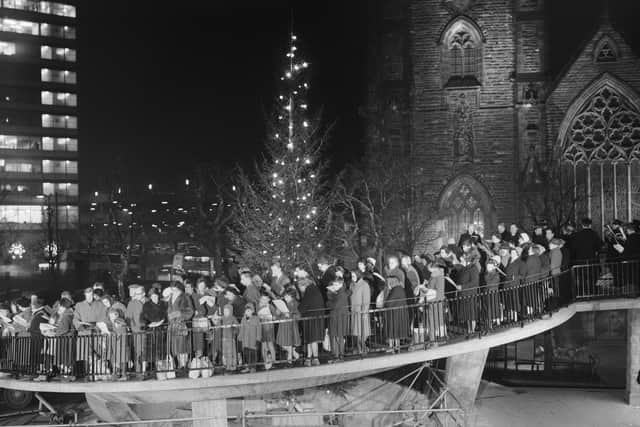

As I’m sure many others will agree, once you get beyond childhood and become a teenager, Christmas no longer seems as magical.
Having your own children does allow you to rediscover this magic so you can make their Christmas as special as possible.
One way to indulge your nostalgia is to look at photos of Christmases past in Birmingham, which give a sense of how much, or perhaps how little, has changed.
If you’ve never looked at such photos, and I’d highly recommend it, you could start by looking at the recently published article on this website,
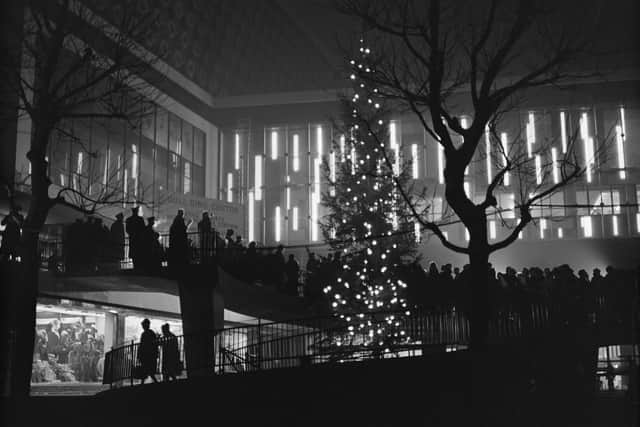
Coinciding with my childhood, these evocative pictures remind me of the Birmingham City Centre I grew up in when there was the fascination of the old Bullring Shopping Centre.
Take it from me, when it was opened in November 1963, the Bullring Shopping Centre was regarded as state of the art, as this YouTube video from 1965 explains here.
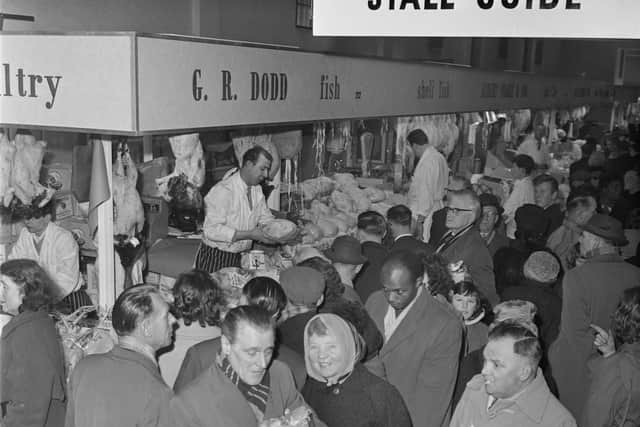
To visit the mammoth Woolworths in the old Bull Ring, a store which until it went into liquidation in late 2008 was perceived to be essential to Christmas, was part of the joy of the festive season.
Amusing as it now seems, especially as the old Bullring grew tired and became widely associated with negative experiences, being able to walk about without being exposed to the elements was revolutionary.
Nonetheless, in the weeks leading up to Christmas, shoppers happily endured streets thronged with people seeking everything required to ensure their festive celebration would be complete.
Remember, for many families who didn’t possess a fridge or freezer, buying the turkey was a matter of waiting until as late as possible and buying the bird complete with entrails, which required preparation on Christmas Eve, ready to be cooked from early on the big day.
However, whilst it’s very tempting to engage in sentimentality and to believe Christmases were better back in my childhood and were more traditional, this would be a mistake.
In fact, and as I’m aware, having written previously, Christmas is a fusion of a number of cultural influences.
Indeed, Christmas, being the celebration of the birth of Christ, didn’t first occur until 226 AD, following the conversion of Emperor Constantine.
Notably, the fact that Jesus’s birth is celebrated on 25th December is something of a conundrum, as the evidence from biblical sources suggests it was likely to have been in September.
However, what we do know is that in Britain, certainly before the Romans came and conquered us in 43 AD, the population then, primarily Iron Age Celts, believed to number around 3 million, acknowledged that the shortest day of the year fell on 21st December, which we now refer to as the midwinter solstice, and was a time to celebrate with festivals of light, feasting and festivities to brighten a gloomy time of year.
The Romans brought with them their own celebration which occurred to celebrate ‘midwinter’ with the week-long festival of Saturnalia, commencing on 17th December, and consisting of feasting, gift-giving, and role reversals and, more crucially, the sun god, Sol, particularly when Emperor Aurelian in 274 AD promoted Sol Invictus, the ‘Unconquered Sun’, as the chief god of the empire.
Once the Christian Church was established as the predominant religion, the 25th of December was chosen as the date to celebrate the Christ’s Nativity (birth), which, of course, still pertains.
Over the next millennium and a half Christmas continued to be a time for celebration consisting of feasting and merrymaking primarily in acknowledgement of the religious significance of the birth of Christ – which would have been considered mandatory – but also as a way to mark the end of one year and the run-up to the new one a week later.
Notably, the Romans celebrated the winter festival of Kalendae on 1st January, the Roman new year, to honour the god Janus.
Religion played a significant part in how Christmas was celebrated throughout the Mediaeval period and Tudor times, though the Reformation under Henry VIII altered the way in which Christmas was celebrated in order to eradicate what would have been seen as the Roman Catholic Church’s imprimatur.
As the state found, eradicating the excesses people all too frequently indulged in when allowed to, proved harder to achieve than might have been thought.
It’s notable that though the Puritans in 1947 banned Christmas in England, Wales, Scotland and Ireland, including anything festive, decorations and public gatherings, this led to widespread rebellions which forced the government to relent.
The Christmas we associate as being ‘traditional’ is a derivation of that which came about during the reign of Queen Victoria and was a consequence of the movement of people from their rural existence to towns and cities to gain employment in the many factories that had opened to produce goods as part of the industrial revolution.
This is true of turkeys, which, though having first arrived in this country in 1526 by sailor William Strickland, having acquired them from Native American traders, didn’t become 'fashionable' for the masses to eat at Christmas until the middle of the nineteenth century.
Christmas trees, an import from Germany and known in England thanks to German migrants since at least the late 18th century, were popularised by Albert and the royal family.
The giving of presents became the norm, and though there had been a character called Father Christmas, it was in the nineteenth century that the one we know today arrived.
In 1864 a character called Santa Claus, widely believed to be based on St Nicholas, or 'Sinterklaas', a 4th-century Greek bishop from Myra, now in modern-day Turkey, featured in a story by American author Susanna Warner.
Significantly, Warner’s Santa Claus, who’d morph into the modern Father Christmas, brought gifts.
Children were led to believe that they would wake on 25th December to find gifts, primarily toys, which had been magically delivered by Father Christmas, who’d travelled from the North Pole on a sleigh drawn by reindeer, including Rudolf.
Undoubtedly, those making toys in the factories were pleased that their merchandise sold so well in the lead-up to Christmas!
And though decorations such as mistletoe and greenery such as holly were part of Christmas, industrialisation created new forms of decoration, which meant that new forms of more colourful adornment became the norm.
Lighted candles were eventually to be replaced by electric-coloured lights, though some purists believe that only white is now acceptable.
Note, if you come to my house over the festive period, you’ll see a mixture, as I still derive pleasure from the coloured lights which remind me of my childhood.
So, for the last 175 years or so, Christmas has been relatively consistent, though the importance placed on it has become much less about any religious aspect and much more about getting together with family and friends to enjoy eating far more than is healthy and to drink larger quantities of alcohol than would otherwise be the case.
Whilst shopping is still a big part of preparing for Christmas, buying products online means that people don’t throng the shops in the same way as I recall half a century ago.
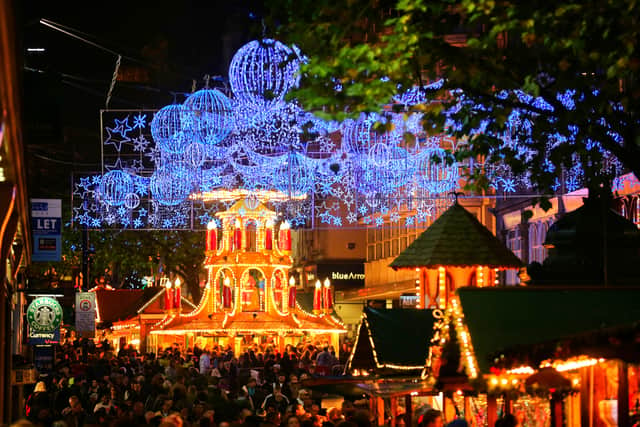
However, as I explained in a recent article, it’s more likely you’ll find huge crowds at the annual Frankfurt Market.
One thing that hasn’t changed in 2,000 years is the willingness of people to get together in Birmingham’s many pubs and clubs for works’ Christmas parties.
Unsurprisingly, television plays a major part in how we spend the 25th of December, though, as multi-channels have replaced only the three available until the early 1980s (ITV and BBC One and Two); even this is now less critical.
It is also undoubtedly the case that one tradition dating back to Victorian times, the sending of Christmas cards, is now in decline as people use electronic means to communicate and, besides, are disincentivised by the spiralling costs of postage.
In conclusion, Christmas, or the celebrations that occur around the 25th of December, has an immensely long lineage and has survived despite major political and religious upheaval.
As to the type of celebrations future generations will engage in, who can tell?
The likelihood is that, as Christmas continues to demonstrate, it evolves and alters in response to changing tastes, new cultures and new traditions.
It’s to be sincerely hoped that the desire of people to wish to come together at this time of year in peace and love for one another will always be paramount.
For Christmas 2025, I wish everyone the very best.