
'Friendly and big-hearted': What visitors would discover if they met the real Brummies
Condé Nast Traveller recently released its list of the UK’s friendliest cities for 2025, with Glasgow again taking the top spot. Birmingham failed to make the top ten.
In early October, Condé Nast Traveller, a British publication that’s part of Condé Nast and owned by Advance Publications, a privately held American media company, which is aimed at those who enjoy travel, particularly “high-end and independent” interaction with locations, published ‘The friendliest cities in the UK: 2025 Readers’ Choice Awards’, writes Dr Steve McCabe.
In the introduction to the article listing the top ten locations worthy of a ‘staycation’ city break in the UK, “The friendliest corners of England, Wales, Scotland and Northern Ireland – as voted for by you”, we’re informed that the criteria – which is not made explicit – is to find charming urban neighbourhoods with their own distinct personality which, as voted by readers, “go the extra mile in making guests feel welcome”.
Without further ado, let me announce, probably to no great surprise for Brummies, that Birmingham does not feature in the top ten, which is topped by Glasgow, which maintains its place from 2024 as the UK’s friendliest city, beating second-place Glasgow.
Notably, the narrative cites what it believes to be Glasgow’s “heartfelt hospitality” as well as its “reputation for knowing how to party.”
Additionally, there’s a description of the cool cocktail bars, numerous historic boozers and legendary music venues which has enabled Glasgow to achieve UNESCO City of Music status.
For good measure, we’re told, those with a penchant for art can visit the many “extravagant” galleries housing thousands of masterpieces and experience the colourful trail of street art.
Forgive me if I’m being a bit pedantic, but this seems to be more about the environment.
Besides, how do you actually measure friendliness, as it’s entirely subjective and based on the individual’s perception of their interaction with ‘the natives’?

I know a great deal about such dilemmas, as in my own doctoral research I utilised organisational ethnography, which has evolved from 1800s anthropology and was initially linked to colonialism, when those from the developed west sought to study and understand non-European cultures.
I’m not going to engage in a philosophical discourse on the basis of Condé Nast Traveller’s system of ranking, which, I discover, is not made public but apparently allows it to use readers’ feedback to compile its ranked list, which celebrates "hospitable communities" and the "warmth" of each city’s residents.
Nonetheless, it would be interesting to know how close Birmingham was to achieving a top ten place in Condé Nast Traveller’s ranking of friendliest UK cities.
Clearly, though, even coming eleventh would mean it wouldn’t feature in the top ten.
Some may ask whether it really matters that much.
I would contend it does, and, as I explained in my most recent article concerning the history of Birmingham’s Frankfurt Christmas Market, if there’s an event sufficiently attractive, visitors will come and, crucially, generate revenue and employment so vital to the city.
Not being featured tells us that Birmingham has more work to do in being seen as a great place to visit and see things such as the Botanical Gardens and wonderful museums we have, as well as an amazing industrial backstory that, in my opinion, we don’t make enough of.
If we compare ourselves to Glasgow, we certainly have a profusion of wine bars, pubs, clubs and restaurants which I’m sure are every bit as good.
Notably, as the news concerning Birmingham City Football Club’s announcement of a new stadium makes clear, there’s going to be a new venue for concerts just outside the city centre which, with the Symphony Hall, Utility Arena, and NEC, will continue the tradition of allowing us to host acts from across the world.
And let’s not forget the musical legacy we have in terms of heavy metal (Ozzy) and rock and pop (ELO, Duran Duran), as well as a variety of other genres.
Pointedly, as a good friend exclaimed after the announcement of the new football stadium at Birmingham City, it takes a couple of brash Americans to provide a vision of what’s possible.
And therein lies the challenge.
Birmingham can, with some justification, claim to have had a pretty poor press recently in terms of the ongoing industrial action by refuse collectors, rats the size of cats, the city council going broke and the incidence of knife crime, including the random and utterly senseless attack on Katie Fox in Smallbrook Queensway in early November, which, tragically, resulted in her death.
Nonetheless, many of the issues confronting Birmingham have been experienced elsewhere, including, notably, Glasgow, which certainly used to have a fearsome reputation for knife crime and deprivation (which I also wrote about a few weeks ago).
Changing the perception of Birmingham is possible, but, Birmingham needs a little more faith in itself’, not despite but because of its recent travails, must think radically and innovatively about how to transform its image, which has been for far too long that of a place where fabulous things are made but the people are somehow dour or uninteresting.
This is, of course, not true, and I’d like to draw attention to the fact that Birmingham came second in a survey of cities with the friendliest neighbours.
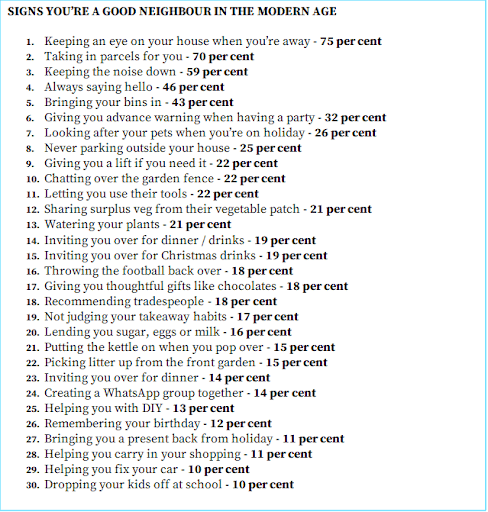
Lily O’Brien’s chocolates commissioned research considering a range of criteria which measure the relationship we have with our neighbours, such as keeping an eye on homes while neighbours are away (80%), taking in parcels (70%), saying hello (46%), looking after pets while owners are away (26%), watering neighbours’ plants (21%), lending tools (22%), always throwing the football back (18%), picking up litter (15%), and being part of a neighbourhood WhatsApp group (14%).
In a statistic that will be welcome to Lily O’Briens, especially given that Christmas is imminent, 48% of those surveyed claimed that giving and receiving presents is a good thing.
As a breakdown of this, the following attracted the following responses as being a good thing to do and receive: chocolates (46%), a bottle of wine (33%), and home-baked treats (25%).
The full list of vital characteristics derived by Lily O’Brien’s Chocolates is shown below:
So, it seems, there are some things that we Brummies can be rightly proud of, though, as is widely accepted, bad news tends to attract more attention than the good.
That said, it’s absolutely essential that those engaged in policy and decision-making about Birmingham’s future do everything possible to improve the city’s image and to ensure that visitors get to meet the real people and not just those drafted in to work on stalls at the German Market or exhibitions regularly held at the NEC.
What they’ll discover are big-hearted people as generous and hospitable as anywhere else in the country.
Dr Steve McCabe
Steve is Professor and Pro Vice Chancellor, DoctorateHub.
Previously, having worked for Birmingham City Council, he spent the last 35 years as an academic at Birmingham City University teaching and researching economics, management and business. Additionally, he has written extensively for edited texts examining economics and politics.
He regularly writes and comments regularly in the national and international media on politics and the economy and has published texts on quality management, benchmarking, ‘Brexit’ and its economic and social impact, the green economy and manufacturing, house prices and India’s progress since independence.