
The surprising history of Birmingham’s Frankfurt Christmas Market
Explore the fascinating history and economic impact of Birmingham's Frankfurt Christmas Market, from its humble beginnings to a major festive attraction.
Our lives are, in large part, pretty mundane, writes Dr Steve McCabe.
That’s the nature of everyday living, and even adrenaline junkies are constantly seeking the next hit.
Nonetheless, we recognise that out-of-the-ordinary events or incidents tend to dominate our memories, which we can, depending on the time that’s elapsed, recall with clarity.
For instance, I can vividly recall where I was just after six o’clock on Saturday, 22nd November 1975.
This was because, as I did for the few months my mother was employed in the restaurant in the basement of the Co-op buildings on both sides of High Street, joined by a pedestrian tunnel, I’d go into Birmingham to mooch around the shops before meeting her when she finished work.
We’d normally get straight on the bus home, but that day we made the decision to take a short detour to visit the Rotunda where, the day before, there’d been a laying of flowers by the families of those who’d died or been horrifically injured in the Birmingham pub bombings.
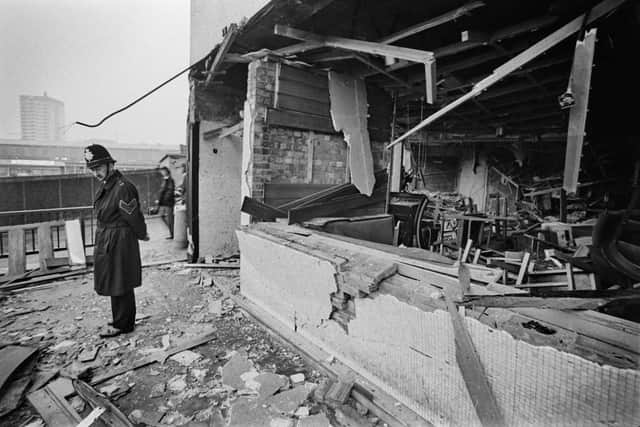

Very obviously, the fact that the city was remembering a dreadful event was bound to stick in my mind, and I recall the atmosphere being understandably sombre; it took years to recover.
What brought this to mind was going into Birmingham recently on a Saturday evening and comparing how much the city has changed in half a century.
Then, licensing laws required pubs to close at 2.30pm in the afternoon and would reopen at 5.30pm and close for the night five hours later.
Even before the explosions in the two pubs on 21st November 1974, which killed 21 and maimed over 200, the city had always had a short period of repose in the period between the closing of shops and the influx of those flocking back into the city to its many pubs.
Anyone wandering around Birmingham in 1975 would discover all commercial activity ceased at 6pm when all the shops closed down.
This included the vast complex, the Bull Ring, which had been completed in the early 1960s, the first of its kind in the UK, and covered 23 acres, of which 33,000 m² was dedicated to retail space (over a third of which was taken by Woolworths).
Contrast this with what Birmingham feels and looks like in November 2025.
Many shops, most particularly in the new Bull Ring Shopping Centre, which was completed over three years and opened in September 2003, remain active well into the evening.
However, without a shadow of a doubt, the big change that’s immediately obvious fifty years on during the six weeks until 24th December is that much of the city centre, especially New Street, is dominated by Birmingham’s annual Frankfurt Christmas Market.
Similar to what happened after the pub bombings when Birmingham’s St Patrick’s Day Parade was suspended for many years, holding a German market in the 1970s would have seemed insensitive to those who’d suffered as a result of the war against Germany under Hitler.
Anyone old enough to remember the bombing of Birmingham by the Luftwaffe will attest to the fear and destruction they caused.
Commencing on 9th August 1940 and lasting until 23rd April 1943, 77 raids by the Luftwaffe resulted in 2,241 deaths and 6,692 injuries.
Though less devastating than the appalling loss of life but nonetheless critical, 12,391 houses were severely damaged, as well as 302 factories and 239 other buildings destroyed.
One example of a direct hit in the city centre was to the buildings on New Street (opposite The Odeon) and extending round into High Street, which resulted in complete devastation. It meant the site had to be cleared, which, for a number of years, was used for car parking and, notably, circuses, which gave rise to the site being colloquially known as ‘The Big Top’ even after it was rebuilt.
It would take over half a century for a German market to be attempted in Birmingham.
A relationship between Birmingham and Frankfurt that had been established in 1996 led to the suggestion by Kurt Stroscher, Frankfurt's director of festivals and events, that a market held in Birmingham at Christmas would be a great way to attract visitors to visit his city.
Consequently, in 1997, a small market consisting of a mere 10 stalls occurred in Victoria Square and proved to be such a success that the city council in Birmingham decided a bigger market should happen.
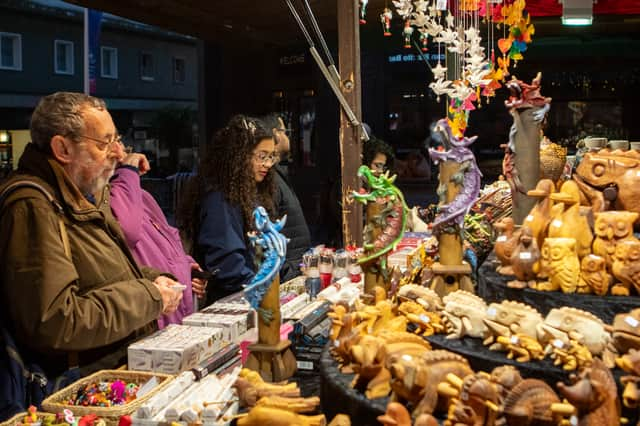
Though it took four years for this to happen in 2001, when 24 stalls operated, the Birmingham Frankfurt Market has now become an annual event in the lead-up to Christmas and has almost trebled in size and attracts visitors from across the Midlands and other parts of the country to consume hot glühwein, schnitzel, bratwurst, German beer, sweets and cakes, as well as handcrafted items, decorations and jewellery.
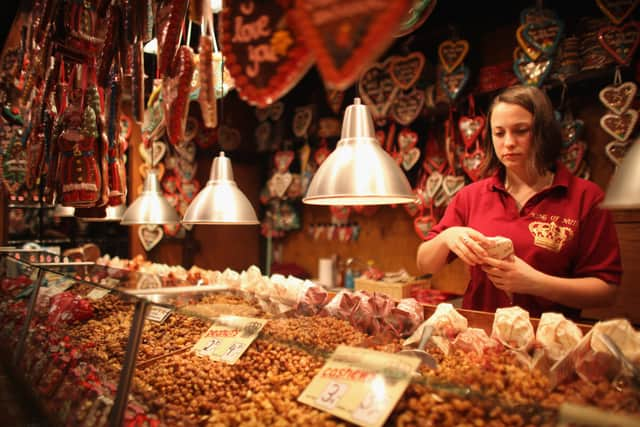
A five-year partnership deal between Birmingham and Frankfurt, operational since 2023, has secured the immediate future of the market, which will attract millions of visitors to the city during its seven-week stint this year and, vitally, generate over £350 million for the city through direct spending at the market as well as secondary spending on accommodation, transport, meals and visits to shops.
A cursory examination of stats suggests it’s estimated that some 7,000 jobs exist as a direct result of the Frankfurt market operating each year.
Clearly, German markets are good for the economy of cities in which they are held, hence the fact that it’s almost impossible to visit any major town or city and not see one.
Unsurprisingly, the tradition of holding markets in the run-up to Christmas is not new here or, more especially, in Germany.
Vienna claims to have the oldest market, which, in 1296, occurred when Duke Albrecht I allowed a 14-day fair in December.
In 1384, Wenceslas IV, king of Bohemia, decreed the city would hold a free market allowing butchers to sell meat prior to Christmas.
Intriguingly, the history of linking of markets held in the lead-up to the celebration of the birth of Christ is somewhat vague, and it appears the first such German cities to do this were the Dresden Striezelmarkt in 1434 and the Nuremberg Christkindlesmarkt, which commenced in 1628.
In her 2022 Smithsonian article, ‘A Brief History of Christmas Markets’, Elizabeth Djinis considers the way in which markets dedicated to the sale of buy meat, baked goods and other commodities families would typically purchase for the festive holiday were usually located near churches and imposed a charge on the stallholders in order to generate revenue.
As Djinis explains, as society became more ordered and towns and cities developed as a result of industrialisation, greater regulation was considered necessary to control what could and could not be sold and the days and hours of trading.
As she relates, a Frankfurt police order in 1869 stipulated its Christmas market must only take place from 5th December to 1st January – no sales being allowed during mass on 25th, 26th and 1st January.
Moreover, only “genuine Christmas objects” could be sold, including “children’s toys, Christmas trees, nativity scenes, gingerbread and confectionery.”
Djinis describes how, as department stores selling mass-produced goods became more popular, the lure of traditional German markets started to wane and often only happened on the outskirts of towns and cities.
She quotes journalist Hans Ostwald, writing in the 1920s, who described markets in Berlin: “Only the meagre remnants of the Christmas market in the east of the capital city still tempt the desires and the hopes of children.”
In Germany, open-air markets held in the lead-up to Christmas were perceived as anachronistic.
It’s something of a supreme irony that the reason so many enjoy the joys Birmingham’s annual Frankfurt Market does so because of the actions of the man directly responsible for the devastation wrought on the city by the Luftwaffe during the Second World War, Adolf Hitler.
As a way of promulgating Nazi propaganda in the 1930s, the decision was taken to rehabilitate the market held in Berlin back to the city centre, where millions were attracted to the sense of rediscovering a tradition that had all but faded away.
Dirk H.R. Spennemann and Murray Parker, academics specialising in cultural heritage management at Charles Sturt University in Australia, writing for Heritage journal, explain that the Nazis decreed that all items sold in markets held in December should reflect national pride and be related to the holiday, including bratwurst, herring and other German beers:
“While claiming to be rooted in tradition, critical to these developments was the transformation of the Christmas markets from a primarily mercantile operation to an experiential event.”
Djinis explains that organisers of markets used “garlands, glass balls and fairy lights”, which had become popular at Christmas, to create a festive atmosphere where visitors could be enchanted by the experience.
After the war, increasing wealth and desire to celebrate the end of the year and prospect of holidays at Christmas in Germany led to a reemergence of the popularity of ‘traditional’ markets with more than a passing resemblance to what the Nazis sought to achieve and, of course, what we’ve enjoyed here in Birmingham over the last three decades.
The abiding popularity of markets at this time of year is based in large part on immersing ourselves in nostalgia and, it may be argued, an idyllic time which, in reality, never actually existed (possibly a reason we flock to the theatre over the Christmas period).
So, the next time you tuck into an unfeasibly large bratwurst and German beer, as well as taking a sharp intake of breath at the cost, take a moment to reflect on the history of the Frankfurt Market in Birmingham.
Dr Steve McCabe
Steve is Professor and Pro Vice Chancellor, DoctorateHub.
Previously, having worked for Birmingham City Council, he spent the last 35 years as an academic at Birmingham City University teaching and researching economics, management and business. Additionally, he has written extensively for edited texts examining economics and politics.
He regularly writes and comments regularly in the national and international media on politics and the economy and has published texts on quality management, benchmarking, ‘Brexit’ and its economic and social impact, the green economy and manufacturing, house prices and India’s progress since independence.