
Our hard times never end - Birmingham's deprivation still defines too many lives
Despite the gleam of new towers and HS2 progress, deprivation still grips Birmingham’s inner districts.
Hard Times, Dr. Steven McCabe takes an indepth look at the latest rankings on UK deprivation with Birmingham named as second highest.
The title of this article is loosely based on the 1854 novel by Charles Dickens in which, unusually for him, the characters experiencing the travails of post-industrialism are based in a fictional Northern mill town called Coketown.
Though containing the usual literary flourishes Dickens was well known for, at its heart, Hard Times is a trenchant critique of the then dominant philosophy of utilitarianism he viewed as being selfish and which created social divides and suppressed imagination in the hope that hard work alone would suffice and bring happiness.
For sure, some 171 years on since Hard Times was published, this country would seem like a very different place.
Read more here: The 10 Birmingham neighbourhoods facing the sharpest decline as city named UK's second most deprived
Dickens is known to have visited Birmingham on three separate occasions in 1844, when he spoke at Birmingham Polytechnic Institution, 1853 to give a public reading of A Christmas Carol in December 27th at the Birmingham Town Hall, and in 1870 to present prizes and certificates at the Birmingham and Midland Institute only a few months before his death on 9th June 1870 aged only 58.
In his visits, Dickens would have seen first-hand the huge social and technological changes driven by the industrial revolution Birmingham was undergoing.
Peter Jones, in his 2009 book Industrial Enlightenment: Science, technology and culture in Birmingham and the West Midlands, 1760–1820 (published by Manchester University Press), draws attention to the fact that because Birmingham was both landlocked and not on a major river, it concentrated on making small metal items, including buttons, guns and, of course, jewellery.
As a consequence, Birmingham’s economy allowed higher wages to be paid, particularly to those who had developed specialised skills and were willing to innovate.
Naturally, as we’ve seen in recent years in China, workers were attracted from the countryside to come to Birmingham in the hope of increased wealth and better prospects for their children.
In 1854, Birmingham was a thriving town – it didn’t receive city status until January 14th 1889 – and was a major intersection in the systems of canals so vital to early industrialisation and was already linked to the new railway lines that would revolutionise commerce and the social fabric of Britain.
Curzon Street, central to the high-speed line to London currently under construction, had opened on 24th June 1838, and the ‘old’ and extremely elegant New Street Station, which was demolished to make way for the monstrosity which replaced it in 1967, had opened on 1st June 1954.
If you’ve never seen pictures of the original New Street Station, I’d strongly recommend doing so as you’ll see how magnificent its was and had the largest single-span arched roof in the world measuring 212 feet wide and 840 feet long.
So far, so good.
Birmingham was certainly a place to make things done and to secure employment.
However, as Dickens wrote about the workers featured in Hard Times, life for Birmingham’s workers and their families could be tough, and living conditions rudimentary and all-too-frequently insanitary.
Birmingham’s three story ‘back-to-back’ housing, the remainder of which are maintained on Hurst Street by the National Trust and can be visited, were extremely cramped and access to running water and to the toilet required a visit to the communal courtyard.
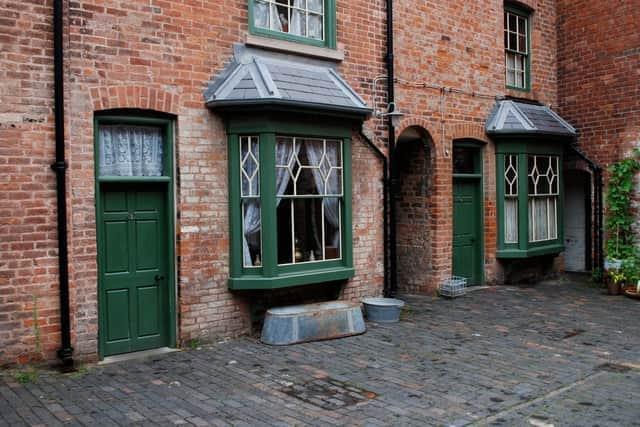

Poor health and child mortality were such that by the end of the century average life expectancy was still around 45 years for men and 49 years for women.
Increased social benevolence and foresight resulted in back-to-back housing being deemed so unsatisfactory that the Public Health Act 1875 was passed, which outlawed future construction, which would instead be replaced by terraced houses, many with gardens, which still exist today in parts of the city.
For so many who left their bucolic existence behind in the search for riches, living and working in mud nineteenth century towns such as Birmingham was surely mixed blessing.
The graves excavated in Park Street in preparation for the arrival of HS2 bear testimony to the dreadful industrial injuries borne by workers and their children who departed this world far too soon.
Deprivation, defined by the Cambridge Dictionary to be “a situation in which you do not have things or conditions that are usually considered necessary for a pleasant life”, was all too rife here in Birmingham in the year his Hard Times book was published.
Assuming it were possible, what would Dickens make of contemporary Birmingham?
Undoubtedly, he’d marvel at how clean everything looked primarily because of the disappearance of the factories belching out fumes caused by the widespread burning of coal as well as the plethora of noxious chemicals used in production.
What he might ask, is the main employment now?
The answer is that Birmingham has switched from being a city which has lost its tradition of manufacturing and is now services-orientated; hence, the shiny buildings that populate parts of the city centre.
However, as would need to be explained, services include retailing, and there would need to be clarification for the worrying number of vacant shop units in every part of the city.
One thing Dickens would note would be the fact that Birmingham’s streets in 2025, whatever you may think, are a lot cleaner than 171 years ago.
Prior to the advent of the motor engine, it would’ve been a constant job cleaning up the detritus (poo) of horses pulling carriages carrying goods and people.
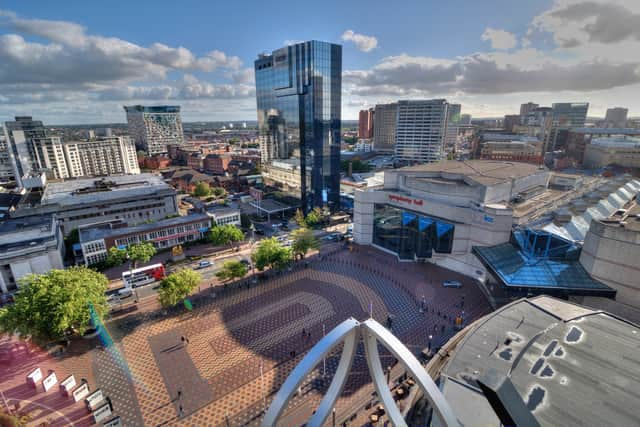
Dickens would note the dreadful back-to-back housing hurriedly built to cope with a rapidly expanding population attracted by employment in the newly opened factories have been consigned to history and that internal plumbing, running water and heating fuelled by gas or electricity is now pretty standard.
He might also wonder at the high-rise office blocks, which are regarded by many as testimony to the dominance of commerce.
On face value the imaginary time traveller might conclude that all-too-ubiquitous deprivation of mid-nineteenth-century Britain has been, like the back-to-back houses, consigned to history.
How wrong he’d be.
Though it’s accepted that any comparison between contemporary Britain and that of 1854 is always going to be fraught with difficulty, the belief that Birmingham’s position as a place with untrammelled potential for advancement of entrepreneurs and innovators as well as prosperity for workers is assured, as would have been the case 171 years ago, can no longer be assumed.
A recent report produced by the Ministry of Housing, Communities and Local Government (MHCLG) , and based on data summarised in the graphic below show Birmingham to be second highest Local Authority District in terms of deprivation in its neighbourhoods in England:
In what is an extensive report worthy of reading, the so-called ‘Indices of Deprivation’ (IoD) refers to people’s “unmet needs”, whereas ‘poverty’ refers to the lack of resources required to meet those needs or socially perceived necessities.
What is clear is that despite the advances that were made in the post-war period of construction and redevelopment, when Birmingham in the 1960s was considered so economically prosperous as to not require investment or support from Central Government, currently in far too many parts (neighbourhoods) of the city, there is endemic deprivation that is blighting the lives of citizens.
As English indices of deprivation 2025: statistical release makes clear, Birmingham’s current situation is that whilst not all areas suffer from deprivation, the city centre is surrounded by inner city districts in which deprivation is all-too-starkly apparent in the data analysed by MHCLG.
However, deprivation is not confined to the inner city, and, according to analysis carried out by the Birmingham Mail, Druid’s Heath and Frankley to the south of the city are the postcode districts with the highest levels of deprivation.
Estates in these areas were built by the city council to rehouse those whose homes were being demolished as part of the post-Second World War slum housing clearance.
Such problems are, of course, not new, and the city council as well as the Combined Authority have existing strategies to deal with the fact that too many of the citizens live in crowded housing, have income below the national average and, appallingly, children are growing up in homes in which there is a lack of the resources to meet their needs and underpin aspirations to advance.
This was not the case a couple of generations ago when the school system enabled young people to achieve things their parents could only dream of through, for example, apprenticeships in the many large companies in the city or, if they were inclined, to go to university, which used to guarantee well-paid careers.
As I’ve regularly written, a very large number of the parents of school friends worked in manufacturing that was so dominant in Birmingham until the end of the 1970s when, as part of Margaret Thatcher’s quest to become internationally competitive by reducing the costs of production, many factories closed down.
Though perhaps not the most inviting of places in comparison to the production facilities of today, such factories were a million times better than what Dickens would have found if he’d visited any on his three trips to Birmingham in the nineteenth century.
Importantly, they offered decent wages and benefits and, to those recruited from school, the prospects of training and part-time education.
Research carried out by a former colleague showed that when Rover at Longbridge went into administration and closed down 20 years ago, there were many instances of three generations of families losing their livelihood, leaving them devastated and, tragically, with few immediate prospects.
That the MHCLG data shows Birmingham has the largest number of ‘income-deprived’ and ‘employment-deprived’ people in any local authority in England is a direct consequence of the fact that there’s been insufficient replacement of the decent jobs lost in manufacturing over the last four decades.
Regular well-paid employment for those who are unemployed or, to use the current parlance, ‘economically inactive’ (those of working age who don’t work) is crucial to well-being and reducing the blight of deprivation in Birmingham highlighted by the data presented by the MHCLG.
This is not to underestimate the herculean task of addressing the other social issues confronting those living in deprived neighbourhoods that have been made worse by the financial constraints imposed on the city’s council.
Given the current ‘mood music’ emanating from the government, most particularly Chancellor Rachel Reeves, that more taxation will be required merely to comply with fiscal rules and attempt to assuage the money markets, we shouldn’t rely on vastly increased money from Westminster to deal with deprivation and poverty in Birmingham.
Therefore, Richard Parker, mayor of the West Midlands, should be applauded for recently announcing an ambitious plan to assist 93,000 people into what he calls “quality jobs” over the next decade in the region, which would, if successful, have a positive impact for Birmingham.
For the collective sake of Birmingham, we must hope this plan succeeds, as otherwise far too many, especially the next generation, will face continuing to endure the sort of hard times written about by Charles Dickens almost two centuries ago.
Dr Steve McCabe
Steve is Professor and Pro Vice Chancellor, DoctorateHub.
Previously, having worked for Birmingham City Council, he spent the last 35 years as an academic at Birmingham City University teaching and researching economics, management and business. Additionally, he has written extensively for edited texts examining economics and politics.
He regularly writes and comments regularly in the national and international media on politics and the economy and has published texts on quality management, benchmarking, ‘Brexit’ and its economic and social impact, the green economy and manufacturing, house prices and India’s progress since independence.