
We're watching West Midlands village full of old world charm on the fast track to becoming a town
Dorridge – A village no more? Dr Steve McCabe delves into news plans to turn Dorridge and surrounding villages into a town
Dorridge is a place I know reasonably well, having visited it on a number of occasions in recent years for various reasons and, occasionally, having cycled there.
Because I usually travel on the Chiltern Line from Birmingham to Marylebone in London, I pass through Dorridge on the train and am always struck by its apparent charm and elegance.
Undoubtedly, there’s prosperity, which a walk around the place will demonstrate.


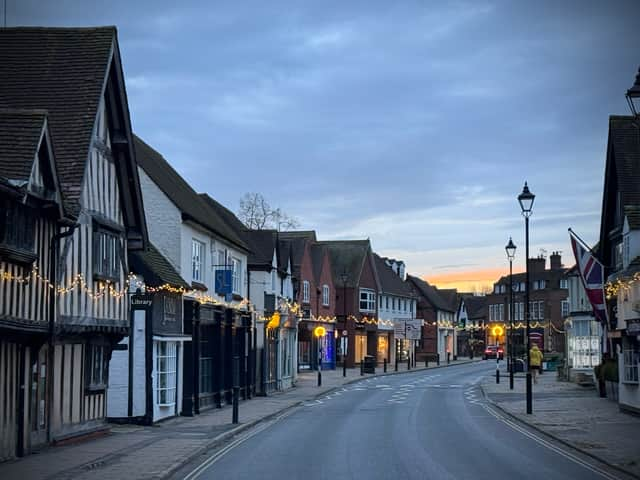
Only 11 miles away from Birmingham – just over 15 minutes on the train – it exudes a sense of old-world charm in the fact that timber-fronted buildings are very much in prominence and feels similar to Bournville, which was created by the Cadbury family for its workers as an idyllic village to live and bring up their families.
However, any comparisons with Birmingham are problematic.
Though Dorridge is geographically separate from Solihull, under which it is administered, in terms of the wealth of its 11,000 citizens, it’s seen as being at the upper end of wealth.
There’s no doubt that to afford to live there, you need to be on a pretty hefty salary or have a decent amount of accumulated wealth to have any chance of buying a property there.
According to estate agent Rightmove’s website, “House prices in Dorridge have an overall average of £679,409 over the last year.”
Comparable figures for Birmingham and Solihull are £254,672 and £395,405.
Dorridge is a highly desirable place to live and, judging by the number of those getting on the train to London, is home to many who regularly commute to London.
Therefore, the news that Dorridge is, as well as near neighbours Knowle and Bentley Heath, under new planning proposals discussed recently at Solihull Council, to be treated as a single town.
And it’s the word ‘town that has set hares running in Dorridge.
It would appear that this move is not going to be welcomed by many local residents in Dorridge who see it as diminishing their sense that it is no longer an isolated village in which the world passes by.
There also appears to be fear that the proposed arrangement will mean that Solihull will attempt to allow more development around the place.
This would, in turn, result in the number of residents increasing with an attendant spike in demand for schools and doctors as well as general congestion.
In addressing the overcrowding that is being experienced in Birmingham, a city which is due to increase by, it's estimated, at least 100,000 in the next quarter of a century, some may argue that new houses have to go somewhere, so why not in rural areas surrounding places like Dorridge?
This argument, which appears to have sympathy within government, is one that will inevitably be rejected by residents who fear their way of life will be negatively affected by an influx of additional residents.
Moreover, in terms of simple supply and demand, building more houses might have the potential of reducing the average price received by sellers of property in Dorridge.
However, I’d suggest it would take a monumental number of houses to be built to reduce the prices of houses that are already well above the average prices for properties in Birmingham and Solihull.
Affordability for those wishing to buy housing is highly unlikely to be resolved unless developers are intending to build property that is so small as to be a real challenge for the families who might buy them.
Additionally, there would be the not so small matter of creating the infrastructure to cope with any large-scale development that might occur were Dorridge to increase in size.
Nonetheless, roughly 45 years ago, Solihull went through a not dissimilar process when developers significantly increased the number of houses available in the area known as Hillfields and Monkspath.
Many older Solihull residents passionately believed their ‘village’, as Solihull used to be referred to, would be irrevocably altered.
They were right in that Solihull changed from a relatively sedentary town to the bustling place it is now.
It’s acknowledged that the building of the Touchwood Shopping Centre in the early 2000s concentrated retail trade away from Mell Square, a 1960s development which, at the time, most definitely permanently changed Solihull from the sleepy village it had previously been.
How to cope with population increase and where to build new houses are extremely difficult and complex challenges which, naturally, require carefully thought-through solutions.
I suspect that the residents of Dorridge, Knowle and Bentley Heath would largely prefer that nothing changed.
Unfortunately, as we all tend to experience, change is the only constant in life.
Most likely, any new development will occur over a long period, and, like the analogy of a frog being boiled, residents of Dorridge will gradually acclimatise to the new normal.
Crucially, though, it’s essential that developers play their part by being made to invest in the services that will be essential in coping with any increase in numbers.
For too long, it seems, they have merely done what is good for the short-term profit margin.
Dr Steven McCabe
Steve is Professor and Pro Vice Chancellor, DoctorateHub.
Previously, having worked for Birmingham City Council, he spent the last 35 years as an academic at Birmingham City University teaching and researching economics, management and business. Additionally, he has written extensively for edited texts examining economics and politics.
He regularly writes and comments regularly in the national and international media on politics and the economy and has published texts on quality management, benchmarking, ‘Brexit’ and its economic and social impact, the green economy and manufacturing, house prices and India’s progress since independence.