
To call thriving Birmingham suburb a slum is as ludicrous as it is dangerous
Shadow Secretary Robert Jenrick's description of Birmingham's Handsworth as a "slum" has faced backlash, highlighting the area's diverse community and economic challenges, writes Dr Steven McCabe.
There’s a maxim suggesting that those in the public eye must either be loved or be hated but that the worst thing that can be experienced is to be ignored.
Politicians appear to be only too aware of the need to remain relevant and be in touch with what the public at large appear to believe.
Shadow Secretary of State for Justice Robert Jenrick, who was born just up the road in Wolverhampton in 1982 and grew up in Shropshire near to Ludlow, certainly seems to adhere to this belief and has attracted immense publicity for comments he made at a dinner back in March.
Jenrick, who has a form for engaging in stories intended to create internet interest, had been to Handsworth in Birmingham to examine the state of rubbish on the streets, which, it should be stressed, was a real problem, as the impact of the refuse workers’ dispute was starting to have an impact across the city.
That he’d have seen piles of rubbish would hardly have come as a revelation.
However, it’s his observations about Handsworth that have caused a maelstrom of controversy and resulted in opprobrium being heaped on him.
For the record, here are his thoughts on what he experienced during the ninety minutes he spent in Handsworth:
“…it was absolutely appalling.
“It’s as close as I’ve come to a slum in this country.
“…..it was one of the worst integrated places I’ve ever been to.
“In fact, in the hour and a half I was filming news there, I didn’t see another white face.
“That’s not the kind of country I want to live in.
“I want to live in a country where people are properly integrated.
“It’s not about the colour of your skin or your faith, of course it isn’t.
“But I want people to be living alongside each other, not parallel lives.
“That’s not the right way we want to live as a country.”
Handsworth, an inner-city area of Birmingham, has, according to the 2021 census, 11,814 citizens, a figure that seems low when, in the 1881 census, this figure was 32,000 and, by 1911, had swelled to well over double this to reach 68,610.
It’s a fair bet that had Jenrick been able to time travel back to 1881 or 1911, he’d have seen far more white faces, as though the district had become built up to cope with workers drawn to the city due to rapid industrialisation. Mass immigration from outside the British Isles, most particularly from the Caribbean and South Asia, did not occur until after the Second World War.
Handsworth’s ethnicity altered from the 1960s as new arrivals moved to an area characterised as having streets in which there was a wonderful mixture of architectural types and periods and “among them some of the finest Victorian buildings in the city”.
In 1978 and listening to punk and new wave as a sixth former, Handsworth became a place of fascination because of the connection to this genre through ‘Rock Against Racism’ by the reggae group Steel Pulse, whose members had met whilst at Handsworth Wood Boys School.
Birmingham was, at that point, truly a melting pot of emerging musical styles and cultures underpinned by the children whose parents had come to Birmingham seeking, as previous migrants had done since the beginning of the Industrial Revolution, work leading to opportunity and prosperity for them and their children.
Which brings us to the current composition of ethnic groups in Handsworth.
According to the 2021 census, 91.3% of Handsworth is ethnically a minority and largely non-white.
Pakistanis are the largest group (25.1%), followed by Indians (23.1%), Bangladeshis (10.2%), White (8.7%), Caribbean (8.2%), and Black African (7.8%).
The remainder of the population is 3.4% mixed, 0.4% Chinese and 6.5% other ethnic groups.
Birmingham City Council provides a Handsworth Ward Factsheet in which there’s a table summarising how the ward compares to the rest of the city and England:
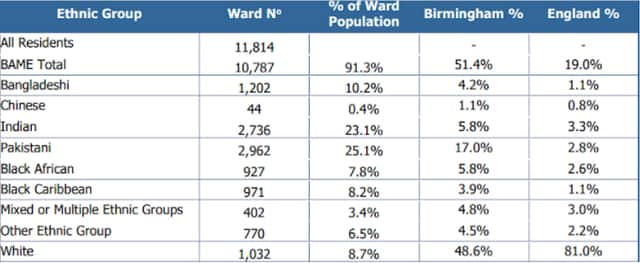

As this factsheet explains, Handsworth has a younger age profile than Birmingham as a whole and is “amongst the more deprived wards” with the “6th highest share of residents with no qualifications of the 69 wards in the city.”
If Jenrick sensed any sense of despondency amongst those he encountered, he’d surely have heard about the barriers to employment experienced by young people and the lack of opportunity to break the cycle of poverty pervading the community.
Stats available show that the employment rate in Handsworth is lower than the average for Birmingham.
Notably, 15.8% of citizens of Handsworth either don’t speak English or do not speak it well; that undoubtedly creates a severe impediment to gaining employment.
Clearly more work needs to be done in creating an increase in proficiency in English, though, of course, this is no guarantee of gaining useful employment or stimulating greater integration, as Jenrick believes is necessary.
However, what Jenrick appears to be trying to achieve is to tap into the current zeitgeist among those aligned to the right that mass immigration is the reason for their economic prospects being undermined.
Forgive me if we’ve heard this before in recent years.
It’s a case of ‘otherness’ with resonance to Brexit, the vote nine years ago which resulted in the UK leaving the European Union (EU).
Among the reasons many were believed to have voted to leave the EU was the belief that jobs were being taken by those who’d come from other member states, especially eastern countries.
Not having produced the economic benefits promised by advocates of leaving the EU, advocates of leave are now without any shame whatsoever and are turning their ire on those who, in Jenrick’s eyes, are not sufficiently white or, for that matter, integrated.
What can be said with absolute certainty is that there’s much work to be done to improve the prospects of many of the citizens of Handsworth, Robert Jenrick, who would have been well served if he’d been willing to listen rather than engaging in what many, including those from within his own party, see as reckless judgementalism and overt racism.
Moreover, Jenrick should understand that Handsworth’s residents live very happily alongside each other and positively celebrate their diversity and ability to engage with other cultural influences, precisely what has made Birmingham such a vibrant and exciting city.
It’s to be noted that many will have come to Birmingham with the wide-eyed enthusiasm of previous migrants to make a better life for themselves and their families.
That the current economic crisis has created greater levels of poverty is not their fault.
As I’ve written previously, jobs in factories requiring no formal qualifications, previous experience, or ability to speak perfect English have largely disappeared.
What’s urgently required are alternative employment opportunities, not just to resolve the immediate challenges facing the citizens of Handsworth, but to create a potential solution to the wider macroeconomic issues that will confront this country.
Richard Davies is a professor at the London School of Economics and Director of the UK’s Economics Observatory. In his recent Observer article, ‘Britain’s high borrowing costs and low fertility rate could trap us in a debt doom loop’, he addresses the fact that currently the UK has to pay in excess of £110 billion in interest on our debts, almost three times as much as was required only a decade ago.
One issue highlighted by Davies was the fact that the replacement rate for the UK – the fertility rate required to maintain a stable population size – is well below 2.1 per female.
This has a significant implication for the economy, as without sufficient babies being born, the future workforce will markedly decline, meaning, in turn, vastly reduced taxation that is required for all the vital expenditure such as education, health services, defence and all of the other aspects of state intervention we take for granted and make this country so attractive.
One benefit in particular, the state pension, is causing concern among economists considering the future.
At present it costs £2 billion a year, but as ‘baby boomers’ born in the 1950s and 1960s retire and, due to medical and lifestyle improvements, live longer, this is likely to double or potentially quadruple.
Concerns that the workforce may shrink would mean it becomes a more significant proportion of the country’s GDP (Gross Domestic Product); hence, speculation that the state pension age may have to rise to, as some have suggested, well into a person’s 70s.
These are the realities facing the current and future governments.
Previously, in order to increase the workforce, as was the case in the decades immediately after the Second World War, immigration was the method used, and that is the reason why the ethnic mix of Handsworth altered.
However, though immigration remains a way of filling roles and importing much-needed expertise, as well as attempting to maintain the UK replacement rate, the mood among those such as Jenrick would appear to be that it should end.
Jenrick’s comments, which have been roundly condemned as being racist and “wrong” by former West Midlands Mayor Andy Street, would, if immigration were to be vastly reduced, lead to very significant economic harm to the UK and possibly mean there’s insufficient money for vital services and benefits.
Very sadly, of course, financial considerations are not uppermost in the minds of those who regard non-white faces to be either problematic or a threat to the ‘British way of life’.
As such, the logic of those who believe Britain will become a better place by somehow becoming what they consider ‘pure’ – usually taken to mean Anglo-Saxon – is as ludicrous as it is dangerous in its potential to undermine harmony between different communities.
Dr Steven McCabe
Steve is Professor and Pro Vice Chancellor, DoctorateHub.
Previously, having worked for Birmingham City Council, he spent the last 35 years as an academic at Birmingham City University teaching and researching economics, management and business. Additionally, he has written extensively for edited texts examining economics and politics.
He regularly writes and comments regularly in the national and international media on politics and the economy and has published texts on quality management, benchmarking, ‘Brexit’ and its economic and social impact, the green economy and manufacturing, house prices and India’s progress since independence.