
Birmingham’s prospects are getting worse, this is how most of us feel
Discover how Birmingham is navigating through economic challenges impacting its growth and development, according to Dr Steven McCabe.
Each year think tank Demos and consultancy organisation PwC publish a ‘Good Growth for Cities Index’, intended to indicate how well 50 UK cities, consisting of 340,000 or more people (2019 data), but excluding London, are performing in terms of aligning economic ambition with public value.
As the authors of Good Growth for Cities, Smarter Choices, Better Outcomes How UK cities can rise to the challenge of changing public expectations, put it, is the way in which these 50 cities are ‘prioritising the foundations that support thriving communities and businesses, focusing on local strengths with real economic potential, and delivering outcomes that people can see and feel.’
Crucially, used to create the annual ‘Good Growth for Cities’ report consists of a number of factors:
- Gross disposable household income (GDHI) per head scaled by regional price (13%)
- Income distribution (ratio of median to mean income) (12%)
- Safety: Violence against the person, weapons and drug offences (12%)
- Work-life balance (% in employment (working more than 45 hrs per week) (10%)
- Jobs (unemployment rate) (9%)
- Health life expectancy (9%)
- Housing (housing price to earnings ratio and owner occupation rate) (8%)
- Environment (carbon emissions: grams of Carbon Dioxide (CO₂) for every £1 of GVA generated) (7%)
- Transport (average commuting time to work) (7%)
- High street and shops (store openings and closures) (6%)
- Skills (share of population, aged 16-24 and 25-64) (5%)
- New businesses (new businesses per head of population) (3%)
To provide assurance of validity, the relevance of these factors is tested each year through a poll of around 2,000 ‘UK citizens of working age’.
So, enough of the technical aspects of the index; what’s Birmingham’s index score?
This year it is -0.28, which is a decline from last year when it scored -0.23 and is third from the bottom, above only Bradford (-0.29) and Walsall (-0.32), both of which declined in the index this year.
So, on the basis of this analysis, Birmingham’s prospects are getting worse, which, I’d accept, is probably how many people I talk to feel.
However, one of the images contained in the Demos-PwC report even more starkly indicates Birmingham’s relative position to the other cities by combining the index with projected annual GVA (gross value added) growth:
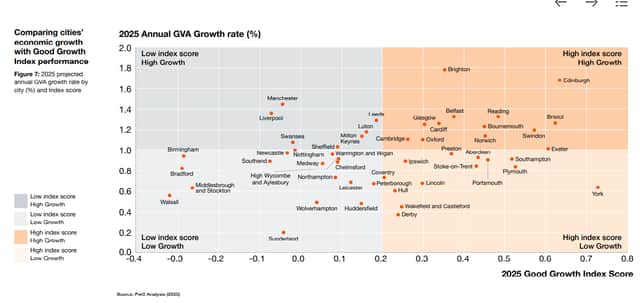

As can immediately be seen, Birmingham is on the lower left-hand side of the matrix consisting of cities with low index scores and low GVA growth.
What’s apparent is that Birmingham is not alone in this quadrant of being a city whose historical origins are in manufacturing.
However, the top right-hand side of the matrix – high index score/high GVA growth – contains a couple of notable examples of cities, Belfast and Glasgow, which, though having experienced a decline in a traditional industry, shipbuilding, are seen to be places with a bright future.
It’s significant that the report presents the index scores for the 16 Combined Authority areas of Great Britain, in which the West Midlands comes bottom.
So, what does the latest Demos-PwC survey really tell us about Birmingham?
Though recognising the fact that the second city contains ‘one of the youngest and most diverse populations in the UK’ and is seen as being central to national infrastructure plans, most particularly HS2, it faces ‘chronic deprivation and exclusion, with record levels of economic inactivity and long-term unemployment.’
That Birmingham has achieved, once again, a low index score in Demos-PwC’s survey merely underlines the fact that whilst there is no shortage of effort or passion being dedicated by a range of organisations in improving every aspect of life, environment and prospects for the city, the challenge remains herculean.
An immediate observation from the matrix shown above is that a number of the cities in the top right-hand quadrant are regarded as popular tourist destinations and trade upon their cultural and historical roots.
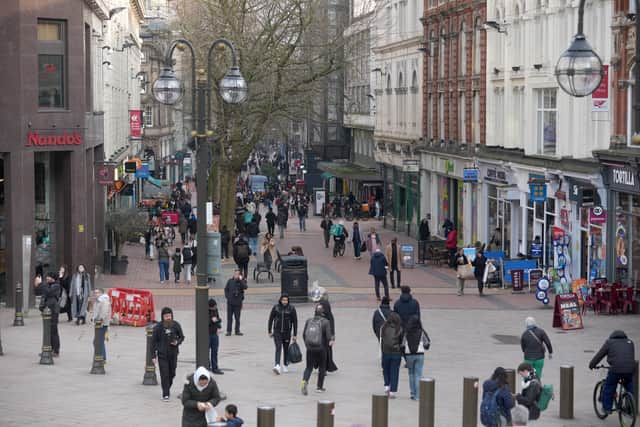
Personally speaking, though I happily acknowledge that the experience of a visitor to Birmingham city centre now is a world away from what would have greeted them on arrival at New Street Station before it was refurbished, I do wonder what they make of the likes of the major streets, which are now characterised by the decline of closed-down premises.
Such decline is epitomised by the fate of former ‘posh shop’ House of Fraser, formerly Rackhams, being a shadow of what it once was.
My own experience of being taken shopping as a child was that New Street, High Street and Corporation Street, as well as surrounding streets, were the places to go to buy things.
At the heart of Birmingham’s plight would appear to be that the massive decrease of available employment in manufacturing, which until the early 1980s provided a significant proportion of reasonably well-paid jobs in the city, has not been replaced with equal opportunities in new sectors such as hospitality.
There’s undoubtedly a cyclical issue: if people have reduced income, they are unlikely to flock to shops in the city centre as they once did (internet shopping notwithstanding).
As Demos-PwC’s Good Growth for Cities, Smarter Choices, Better Outcomes How UK cities can rise to the challenge of changing public expectations acknowledges the main challenge facing the city is in dealing with the immense inequality and poverty that’s apparent if one walks no more than a mile in any direction from Birmingham’s centre.
Of most concern, it stresses, is the east of the city, in which are located 55% of Birmingham’s most deprived wards.
Demos-PwC also note that so-called ‘worklessness’ is a major factor in poverty in this part of the city, with over a third (35%) of residents being economically inactive compared to 23% nationally, and that the twenty wards of East Birmingham's constituencies account for 2% of England’s unemployment.
Whilst the situation is not quite so grim in other parts of Birmingham, this is not to underestimate the phenomenal effort that is still needed by every individual and organisation which is actively working to, as Demos-PwC’s report explains, ‘address shared priorities and unlock funding and finance, along with a wide range of pilot interventions designed to build local economic resilience and social capital, reduce grant dependency, and support local SMEs, co-operatives and CICs.’
The situation has not been assisted by the much-publicised travails the city has suffered in recent years, particularly Birmingham City Council declaring itself bankrupt two years ago and now being the local authority with the greatest debt in the UK (£3.35bn at the end of the 2024-25 financial year).
This has led to savage cuts to vital services, which makes a bad situation much worse for many residents.
That city residents are now well over six months into an ongoing bin strike, with all the attendant publicity dedicated to piles of refuse and alleged rats as big as cats, will have done nothing to make Birmingham an attractive destination for either tourists or investors so vital to create future jobs and prosperity.
The fact that economic growth remains at an anaemic level both locally and nationally makes the task of radical investment and improvement all the harder.
What can be stated with certainty is that there are no easy or quick solutions to the multitude of problems facing Birmingham and the surrounding region.
This, ultimately, means that even greater creativity, ingenuity and innovation become even more essential than they have ever been for those who have a role in ensuring Birmingham can once again be a city its residents are proud of.
Success would be demonstrated by Birmingham being at the top of Demos-PwC’s ‘Good Growth for Cities Index’.
For the sake of the current and future generations, it’s vital we all support this objective.
Dr Steven McCabe
Steve is Professor and Pro Vice Chancellor, DoctorateHub.
Previously, having worked for Birmingham City Council, he spent the last 35 years as an academic at Birmingham City University teaching and researching economics, management and business. Additionally, he has written extensively for edited texts examining economics and politics.
He regularly writes and comments regularly in the national and international media on politics and the economy and has published texts on quality management, benchmarking, ‘Brexit’ and its economic and social impact, the green economy and manufacturing, house prices and India’s progress since independence.