
Birmingham City Council: What life is like in UK's second city that declared itself bankrupt

For many Brummies, summer 2022 felt like the start of a new chapter for their sometimes overlooked and belittled city.
Birmingham, with the world’s eyes upon it, succeeded in putting on a spectacular show for the Commonwealth Games – one that boasted Ozzy Osbourne and a huge mechanical bull.


The impressive celebration of the Midlands created jobs, boosted tourism and left a feeling of hope that it had shifted some outdated attitudes towards Brum.
But the following year would see another event dominate the conversation around Birmingham.
It was back in September 2023 that Labour-run Birmingham City Council declared itself effectively bankrupt, leaving many fearing what that would mean for the city.
It followed a perfect storm of issues which were building up behind the scenes, including the equal pay debacle, inadequate budget setting, the disastrous implementation of a new IT system, demand led pressures and funding cuts.
Anxiety over unprecedented cuts to local services and eye-watering council tax hikes soon swept over Birmingham, a stark contrast to the sense of optimism and pride the Games created.
Roughly a year and a half on, there’s a clearer picture beginning to emerge of what it actually means when a city becomes engulfed by financial turmoil.
From fears over rubbish and rats to battles to save lifeline services, here’s what it’s like living in a ‘bankrupt’ city.
‘Rats chewing through car wires’
Overflowing bins, rubbish bags in the street and a repugnant stench greet me as I make my way through Selly Oak.
A student, who shares a house with six other people, tells me during my visit that the area near the University of Birmingham has been “hit hard” by the ongoing bin strike.
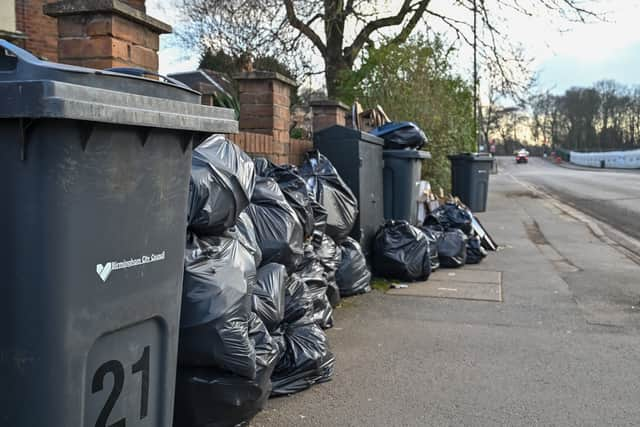
She continues that her recycling bin, filled to the brim with waste, had not been collected in a month and complained about the unpleasant smell lingering over the neighbourhood.
What’s happening in Selly Oak has become a common sight across the city since the start of the bin strike back in January, which Unite the union organised over the scrapping of a “safety critical” waste recycling and collection officer role.
But the city council has insisted that its planned changes for the waste service, included within its latest painful budget and a key part of its recovery plan, would improve the quality of service delivery and safety.
With the collection of recycling suspended and piles of waste outside homes, this very tangible impact of the turbulence within the council is sparking both anger and fears over rats.
Leanne Gregory, an Allens Cross resident, is one of many Brummies having to endure their streets being blighted by bin bags due to the strike, which is set to go all-out from March 11.
“So many issues in this ward,” she said. “We have rats the size of feet, I’m absolutely seething.”
Elsewhere in the city, reporter Naomi de Souza had her own personal experience with rats recently as rubbish piled up near her parking space.
“I had called the RAC out because I needed a new battery but upon opening my bonnet, the mechanic was shocked to see a wire in my bonnet had been chewed through clean by rats,” she said.
“The wire was fixed for free as part of my policy but it made me feel angry that this had happened.”

Concerns over rodents were also a recurring theme during this month’s budget meeting, with one Conservative councillor even warning there had been reports of “rats the size of cats”.
The city council has recently said it made a “fair and reasonable offer” to Unite and that alternatives have been offered to the “small number of workers whose wages are impacted ongoing by the changes to the service (of whom there are now only 40)”.
“Residents of Birmingham want and deserve a better waste collection service and the restructure that Unite is opposing is part of the much-needed transformation of the service,” a council spokesperson said.
‘Vulnerable people are going to suffer’
For more than four decades, Jean Cross’ “severely disabled” brother has been attending the ‘lifeline’ Harborne Day Centre.
But he may soon be forced to move elsewhere after cabinet members at the council agreed to close four of the city’s adult social care day centres – including Harborne.
Services are set to move to the five remaining day centres in Birmingham.
The decision has proved highly divisive, leading to angry outbursts during council meetings and protests being held by family members.

“Highly-vulnerable people and their carers’ are going to suffer immensely,” Jean wrote in an open letter. “This closure will have a detrimental impact for my brother, causing distress and unnecessary change to his daily routine.”
But this is not the only way that families of vulnerable residents in Birmingham have been hit by the shockwaves caused by the council’s crisis.
Last year, anxious families were left in a state of limbo when the council took the axe to its special needs transport service.
The changes mean that taxi and minibus services, commonly used to transport pupils to special needs schools, will now only be provided to those of sixth-form age in “exceptional circumstances” – despite still being used for young children.
Sabiha Aziz, a mum to three young people, two with additional needs, said years of fighting for support had left her with a “dark cloud” hanging over her head.
“The council’s financial struggles are resulting in reduced services for SEND families, worsening our ongoing fight to access the support we are entitled to,” she told the Local Democracy Reporting Service (LDRS) recently.
“After years of stress, I have decided to withdraw from several services that once felt essential.
“This decision has brought me a sense of relief, though it also leaves me feeling sad and angry about the situation.”
On the closure of the day centres, Coun Rob Pocock, who is overseeing the council’s transformation, said last year: “We need to save on costs and the remaining centres need to be fully utilised.
“Citizens using our centres have said they want to have a wider variety of activities outside the day centres and this is what we are also developing, as part of a more modern 21st century service”.
On the transport cuts, Birmingham City Council said in 2024 that it recognises that “difficult decisions need to be taken” in order to protect statutory services for vulnerable children and young people, as well as their families.
“We appreciate that the revisions recently made to the travel assistance policy are a big change for those families impacted,” a council spokesperson continued.
“This is why we have given families as much notice as possible and have made support available from the team.”
‘Cultural wasteland’
“It’s going to make living in Birmingham considerably less enjoyable,” campaigner Darren John tells me as we discuss culture cuts.
“I would be surprised if all the cultural events survive the next couple of years.”
Iconic cultural venues in Birmingham are set to lose all their funding from the council in the coming months as the authority pushes ahead with controversial cuts.
The authority revealed last year that grants to regularly-funded art organisations would initially face cuts of 50 per cent and then 100 per cent in 2025/26.
At the time, Stephen Brown, from the Trades Union Congress (TUC), warned Birmingham faces becoming a “cultural wasteland”.
The venues affected include City of Birmingham Symphony Orchestra (CBSO), Birmingham REP Theatre, Birmingham Royal Ballet and IKON Gallery.
The council is also planning to end cultural project grants, which could impact a number of events.
Mr John, who has been fighting to ‘save’ The Electric Cinema in Station Street, wants more to be done to ensure the city’s cultural scene is not neglected.
“Without venues and places for people to practice in, we are not going to get the next Black Sabbath or Steven Knight,” he said.
Looking ahead to the future, he said he had “faith in Brummies” and believed there’ll still be good culture around despite the council’s cuts.
“But there needs to be serious reflection for the city on the story it wants to tell through its culture,” he added.
Speaking to the LDRS last month, council leader John Cotton acknowledged the cuts were a “really difficult decision”.
“That said, I think we’ve still got a very vibrant set of cultural organisations in this city,” he said.
“Culture is extremely important for the citizens of this city and we’re going to do everything we can, as a partner with others, to ensure that remains the case.”