
I miss the days when a firm polite handshake would do
Roshan Doug on the complications of a greeting in today’s modern world
Last week I was on the phone to an American friend, chatting about how communication seems to have become extraordinarily complicated in the 21st century.
When I was growing up in the 1970s, you met somebody, shook their hand, and said hello. If it was a close friend, perhaps you slapped him on the shoulder.
In a world of emotionally charged people, I think there’s a lot to be said for being aloof, reserved, and keeping a stiff upper lip.
I grew up in a very conservative Indian family, and my father was not a man given to displays of physical affection. I cannot remember him ever giving us a hug. It wasn’t because he didn’t love us. Quite the opposite. He came from a generation in which love was demonstrated through responsibility, sacrifice and looking after your family rather than throwing your arms around people.
And my father also believed passionately in a man’s word. When he bought his first house, he agreed the price with the seller in a pub. They shook hands and that was it. No lawyers, prolonged negotiations or lengthy contracts. A handshake was that generation’s equivalent of signed, sealed and delivered.
Later, my father was offered a similar house at a lower price by a man who was eager to sell.
He turned it down instantly. ‘We’ve already shaken hands,’ he said to the desperate vendor. The deal had been done. His word was his bond.

Today, if you said you’d bought a house by shaking hands with somebody in a pub, you’d probably be advised to see a psychiatrist.
My father was aghast at my first collection of poetry – it had intimate references to my feelings, relationships, and love life.
Why, he wondered, would any grown man want to broadcast his private life to the whole world? Understandable in a way. In his generation, some things were simply private.
Which perhaps explains why I, too, find the modern male hug slightly curious.
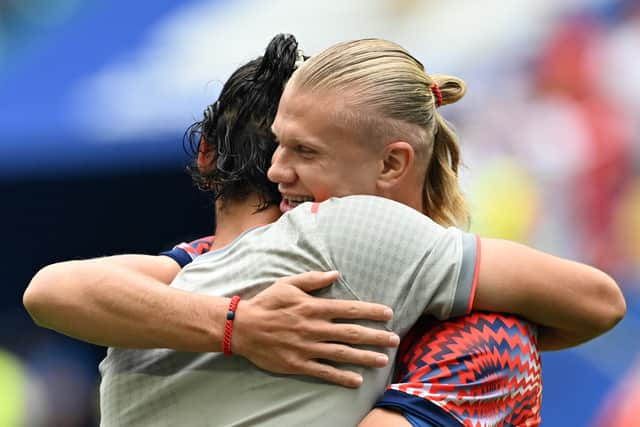
Two men who haven’t seen each other for a couple of days can now approach with arms outstretched andperform what looks like a carefully rehearsed rugby tackle.
I believe men should be men — firm, stoic and steadfast, capable of keeping their emotions reasonably under control. That doesn’t mean men shouldn’t show affection. Of course they should. But I still rather like the old-fashioned greeting: a firm handshake, a slap on the shoulder and, ‘Good to see you, my ol’ mucker!’
I remember once seeing a grown man on MasterChef crying because he’d made a mess of his cheesecake or something. A grown man! I can’t imagine what my father would think!
Then came the kisses.
When I was growing up, kissing someone was unheard of in my family. But in a European context, two kisses now seem to be required when greeting or saying goodbye. Left cheek, right cheek — or the other way around? I’ve never mastered the system.
The danger comes when your kissing expectations differ. You lean one way, they lean the other and suddenly you’re engaged in an awkward piece of facial choreography. Add somebody going for a hug while you’re preparing for a handshake and you have something
resembling a failed dance routine.
And then there are emojis. We used to use words. Now we send tiny yellow faces and expect people to understand precisely what emotional state we’re in. People say they are convenient: I say they’re infantilising.
Even punctuation has become psychologically charged. Apparently, ending a text with a full stop can make you sound cold. Use an ellipsis and you’re just asking for trouble. Three innocent dots have somehow become sinister.
And heaven forbid you use capital letters. Sometime ago, an Australian court considered an email from a manager packed with capitals and exclamation marks and found that it conveyed a tone of anger, irritation and frustration. Highly unprofessional.
I remember when capital letters were simply used at the beginning of sentences. Now they apparently have an emotional temperature. Add an exclamation mark and you’re practically heading for an employment tribunal!
Even death has received a linguistic makeover. We used to say someone had died, but that became ‘passed away’. Now, increasingly, people simply say someone has ‘passed’. Passed what? An examination? GCSEs?
It sounds as though there is an entrance test at the Pearly Gates: ‘Congratulations. You passed. Heaven is through there.’
In a world full of technology, we need the human touch. Give me a handshake, a smile, a straightforward hello and a decent conversation over a cup of tea. I know where I am with that.
The rest feels like learning a foreign language for which nobody has bothered to provide the phrasebook.
And even when you think you’ve finally mastered modern communication, someone sends you a picture of two pineapples upside down. As my American friend said, you really don’t want to go there. Because that’s a whole new language for a very different community!
Roshan Doug is an social commentator and educationalist. He is also a former Birmingham poet laureate.