
Modern slavery: West Midlands Police has one of lowest charge rates in England & Wales

Charge rates for modern slavery offences have dropped every year in England and Wales since the Modern Slavery Act was introduced - here’s what the figures show for the West Midlands
West Midlands Police has one of the lowest charge rates for modern slavery offences across England and Wales in the last eight years.
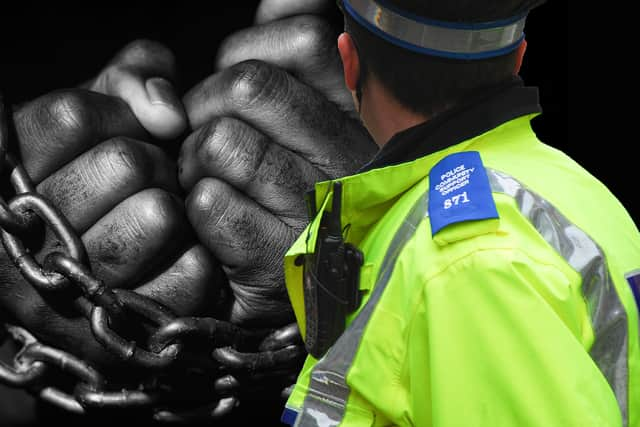
People traffickers, slavers and criminal exploiters are only charged by police across England and Wales in a tiny minority of cases, leaving victims “hugely dispirited”, the publishers of BirminghamWorld can reveal.
The 2015 Modern Slavery Act was introduced to crack down on people traffickers amid a growing awareness of the widespread nature of modern slavery and serious exploitation, allowing for judges to give out life sentences.
Common offences include women being trafficked for sex work and fruit and vegetables pickers effectively kept in indentured labour.
But the charge rate for modern slavery offences has dropped to a new low of less than 2%, with almost 40,000 crimes since 2015 not resulting in charges being brought, according to our analysis of Home Office data for England and Wales.
The investigation comes at a time of increasingly strong government rhetoric about small boat crossings and other irregular migration to the UK, with the Home Secretary pledging to smash the criminal gangs bringing people into the UK – whether through voluntary people smuggling, or trafficking for exploitation.
And Prime Minister Rishi Sunak said people who arrive in the UK illegally, like many asylum seekers and victims of trafficking, would not have access to the modern slavery system under the controversial Illegal Migration Bill.
Experts said this bill, and the Nationality and Borders Act which was passed last year, make things more difficult for victims of modern slavery, which has a major impact on authorities’ ability to prosecute criminal gangs.

Charges brought in less than one in 50 cases
The proportion of modern slavery offences resulting in a charge has dropped every year since legislation was introduced in 2015, reaching a low point in the most recent period (the six months to September last year) of just 1.7%. This leaves the total number of crimes that did not result in a charge since 2015 at almost 37,000.
The number of crimes under the Modern Slavery Act recorded in the first half of 2022/23 rose to a record high compared with the same period in previous years, of 5,173.
In the first half of this year, the majority of modern slavery cases were closed without a suspect being identified. The next most common outcome was ‘evidential difficulties - victim does not support action’.
What do the figures show for the West Midlands?
In the eight years since the 2015 Modern Slavery Act was introduced, there were 3,848 modern slavery outcomes recorded by West Midlands Police (This is not a count of crimes, but a count of outcomes assigned to crimes). Only 51 of the 3,848 outcomes resulted in a charge (1.3%) while 3,797 were not charged.
This the 7th lowest charge rate for modern slavery in England and Wales. The City of London Police had the worst charge rate. 43 total crimes were recorded since 2015, with no charges brought. Dorset Police had the second worst charge rate with just 1 charge from 280 crimes since 2015. Cleveland Police had the third worst charge rate( 0.6%), followed by Gwetn Police (0.6%), Thames Valley (0.7%) and Hampshire Police (1.1%).
A spokesman for West Midlands Police, said: “We continue to work with partner agencies to prevent, raise awareness of and improve the response to modern slavery and human trafficking.
“Modern slavery involves people being trafficked into or around the UK and being forced to illegally work against their will. We have already acted on recent reports of suspicious activity and uncovered suspected sex trafficking at premises in the West Midlands.
“We continue to run operations cracking down on sex trafficking and exploitation in the region and act on intelligence gathered from multiple sources, including local residents and anonymous callers. We also have SOCEx exploitation hubs, which identify risks and help plan operations to prosecute those guilty of modern day slavery.”

‘These cases are “notoriously difficult” to prosecute’
Andrew Wallis, chief executive of Unseen UK, a leading modern slavery charity and designated first responder organisation, told NationalWorld that modern slavery cases are “notoriously difficult” to prosecute, in part because victims are often very vulnerable and hesitant to engage with authorities.
While it is not as simple as blaming just the police or Crown Prosecution Service (CPS) for the failure to bring charges against people traffickers and exploiters,both institutions and the wider justice system could handle the cases more effectively, Mr Wallis added.
He said: “Police need to be not just looking for the crimes, but dealing with victims sensitively, and realising that they’ve got to put in the hard yards to get the sentence. They also need to start financial investigations from the get-go and understand this as an economic crime.
“Secondly, CPS don’t seem willing to prosecute modern slavery offences. They say ‘let’s go for a lesser offence here,’ which sends a message to policing as well. And then I think the judiciary needs training around both what the law says in terms of the level of sentencing that should be taking place, and understanding the vulnerabilities of the victim within these cases.”
The CPS - which is tasked with bringing charges against offenders after the police have investigated a crime and referred it to them - stressed that it can only bring charges where the investigating police force refers the case to them, which does not happen in every instance.
Home Office statement
A Home Office spokesperson said: “Modern slavery is a barbaric crime and we remain committed to bringing perpetrators to justice. We have provided £16.5 million since 2016 to ensure the police have the capability needed to investigate these complex crimes.
“We are working with partners across the criminal justice system to increase the number of cases being charged and prosecuted, including by improving support for victims so they can engage with prosecutions and help bring their exploiter to justice.”