
Government urged to listen to disabled people as minister visits West Midlands charity

Those at the charity say the visit comes at a important time, with the government ‘considering changes’ to the welfare and employment support systems.
A government minister has acknowledged during a visit to Birmingham that more can be done to ensure the voices of disabled people are heard.
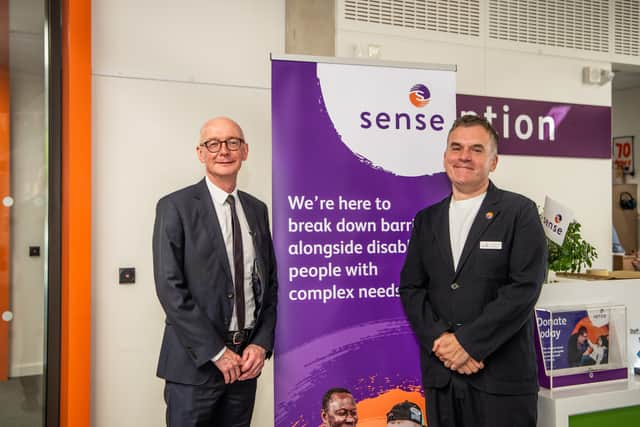
Secretary of State for Work and Pensions Pat McFadden was recently in Selly Oak to visit Sense, a national disability charity which provides support to people with complex needs.
Those at the charity say the visit comes at a important time, with the government ‘considering changes’ to the welfare and employment support systems.
Mr McFadden, who’s also the MP for Wolverhampton South East, spoke to those who depend on Sense about how the development of crucial life skills and employment opportunities can break down the various barriers they face.
Brothers Josh, 22, and Ryan, 18, who both have a visual impairment, some speech difficulties and a hearing impairment, are among those who have benefited from the charity’s support.

They are currently on the Foundation Pathway at Sense College, completing qualifications in maths and preparing for employment, with Josh keen in science and Ryan considering working in the food industry.
Ollie, 25, from Kings Heath, who has developed his academic, practical and vocational skills, is another one of the charity’s positive stories and now volunteers regularly at both the Sense Café and a local urban farm.
“I feel incredibly lucky to have a place like this and have a service that helps him do volunteering at the farm,” mum Tara said. “It’s really important that Oliver is visible and also for him to be helping other people because that’s what he loves to do.”
Meanwhile Sense staff member Hannah Moreton, who uses a wheelchair, supports disabled people to create their own visual arts journey at the charity.
Speaking to the Local Democracy Reporting Service (LDRS), she urged Andy Burnham’s government to include disabled people in the conversations that impact them.
“I think disabled people need to be at the forefront of these conversations,” the 42-year-old said. “I think with anything where disabled people need to be considered, which should be every part of society, they need to be ones who are giving you the information.
“I think that sweeping statements and insecurity through unclear messages […] aren’t doing any good.
“So the key message for the government is that disabled people need to be the ones that they listen to and they need to feel like their voices are being heard.”
Asked about involving people with disabilities in government thinking, Mr McFadden told the LDRS: “I think we can always do better and we should be ambitious.
“We have the Timms Review [of Personal Independence Payment] going on at the moment which is very closely involving people with disabilities.
“We have disability advisory groups at the DWP but it’s something that takes ongoing attention.
“We do care about this but I would be the first to say that I’m sure we can do better.”
On how the government can help break through the various barriers facing people with disabilities, Mr McFadden said: “One of the things I tried to rail against is this culture of signed off and written off, which we see sometimes in these systems [such as the education and welfare systems].
“My view is that the objective of the welfare state should be to help people live the fullest life possible.
“And what that means for people with disabilities is if with a bit of help and support, people with disabilities can work, volunteer or do work experience, we should help them to do that.
“But it’s also true there will be some people who have disabilities so profound that’s simply not possible or realistic – and for people who can never work, the welfare state has to be there to look after them.”
Asked about local authorities facing challenges with certain services, such as Birmingham Council closing four of its day centres for vulnerable adults, Mr McFadden said: “Birmingham’s financial problems are well documented.
“Ultimately the council has to get its financial house in order. I think everybody involved with Birmingham City Council knows that.
“If I can speak more widely, one of the things we’re doing is putting more effort into employment support for people with disabilities and long-term sickness problems.
“We’ve got a programme called Connect to Work, which is a £1 billion investment over the next two years.
“It’s already helped hundreds of people into work in the West Midlands region so that’s a good, valuable programme.”
“If we can get people into productive work, they earn more money, they’re paying their taxes,” the minister continued. “It helps the country’s financial situation but it’s also a great human story.”
He went on to describe Sense in Birmingham as “fantastic”, adding: “I can’t praise this facility and the people running it, working here and the student learning here highly enough”.
‘An important time’
James Watson-O’Neill, chief executive of Sense, said: “The visit comes at an important time as government considers changes to the welfare and employment support systems.
“It is important that the voices and experiences of disabled people with complex needs are at the centre of those changes.”
He continued: “Our guests heard directly from disabled people about their experiences of employment, volunteering and the welfare system.
“We discussed the importance of the right support, and how the benefits system can help meet the extra costs of disabling barriers, enable greater independence and make participation in everyday life possible.”
Mr Watson-O’Neill, told the LDRS: “We’re really excited by the opportunities to work with the government. For us, it’s about connecting it all together.
“We know from the people we support that their lives are about all the different parts of the public state system they engage with – that might be education, a GP, a hospital, trying to get to college, trying to get welfare benefits.
“We want all of those things to fit together.”
He continued: “Here in Birmingham, you want people to be able to get on public transport really easily, move between where they live and where they work, go to a job interview relatively easily, get support from the government for that interview through their access to work scheme.
“All of those things can work really well together if we all try to help each other and Sense I hope is a very important part of that recipe.”