
English pride is back again – now prepare for penalties! Roshan Doug on World Cup dreams
’Southgate lifted some of the weight. He made England feel human again’
There are certain things in life the English have learned never to trust completely: weather, train timetables, and penalty shoot-outs.
And yet here we are again.
Another World Cup approaches, and this time the stage is Los Angeles - the land of celebrity, palm trees, and impossible teeth. Across England, millions of us are preparing emotionally in the only way we know how: by hoping for success whilst bracing ourselves for disappointment.
Supporting England has never been just about football. It’s inheritance. Emotional intensity passed down through generations like old family silver - only ours is scratched, slightly bent, and occasionally hurled across the room after a missed penalty.
I’ve spent most of my life watching England at tournaments with the same familiar mixture of hope, dread, and heart-racing anxiety. Every competition begins with the same vow: This time I won’t get carried away.
By the second match I’m studying formations like military strategy, criticising substitutions, and behaving as though the manager might ring me personally for advice.
Which brings me to Gareth Southgate.
Whatever football history ultimately decides about his time as England manager, Southgate changed something important - something deeper than results.
Of course there were results: semi-finals, finals, near misses, unforgettable nights. But what he changed most was the feeling around England.
Before Southgate, England often looked like a group of gifted men carrying invisible furniture on their backs. The shirt seemed heavy. History heavier still. Tournament football arrived wrapped in nerves before a ball had even been kicked.
Southgate lifted some of that weight. He made England feel human again.
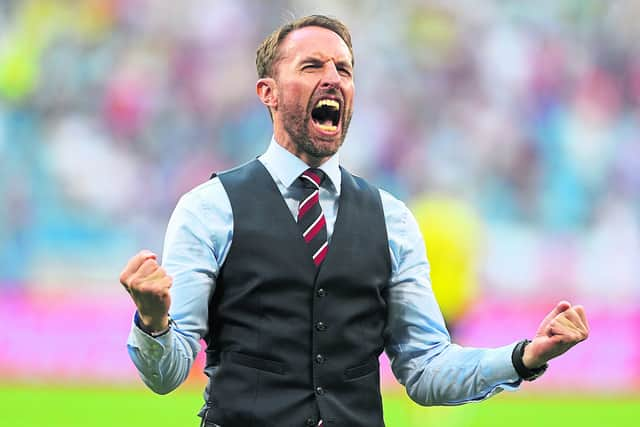

Not unbeatable. Not invincible. Not Bobby Moore’s 1966. Just human - calm, composed, thoughtful and occasionally capable of passing the ball without provoking national panic.
More importantly, he gave England permission to hope again. Which may turn out to be either his greatest contribution or his cruellest.
That’s why BBC’s Dear England struck such a chord. It wasn’t really about tactics or team selection. It was about pressure, leadership, vulnerability and what it means to carry the expectations of a nation without collapsing under them.
What Southgate seemed to understand - better than most - was that England’s football story has never been only about football. It is tied to memory, identity, expectation and national mood. Every tournament feels partly sporting event, partly national therapy session.
And then, of course, there will be penalties -it’s the albatross around our necks. Part of the hurt.
But - strange as it might sound - nothing captures the English spirit quite like a penalty shoot-out.
The slow walk from the halfway line. You can almost hear Henry V’s ‘We few, we happy few, we band of brothers’ echoing through England’s summer rain and green meadows.
The fixed stare of a player trying to appear calm while clearly negotiating privately with God - or the universe.
The goalkeeper waving his arms like a man directing aircraft on a runway.
The commentator whispering, ‘England have prepared thoroughly for this.’
Yes, but have they prepared enough?
I have lived through penalties in every possible position: seated rigidly, standing behind the sofa, pacing my study, hiding behind a cushion, walking out of the room entirely, or pretending to make tea while listening from the kitchen for crowd reaction.
None of it changes anything.
And yet I - and we, as a nation - do it every single time.
That is the extraordinary thing about following England: the optimism somehow renews itself despite overwhelming historical evidence to the contrary.
Which is why Los Angeles feels like the perfect setting for a World Cup.
Hollywood understands drama better than anywhere on earth. It understands impossible dreams, glorious triumph, emotional collapse, redemption and endings nobody saw coming.
England at a World Cup is essentially cinema. Only with shin pads.
And back in Blighty, there is always something magical about the tournament itself. Streets feel different. St George’s flag on vehicles. And pubs fill early. Families gather around televisions. Strangers suddenly become tactical experts. People who haven’t watched football for four years confidently announce, ‘We’re lacking width,’ or ‘What in God’s name is he doing at the back?’
Entire nations collectively lose perspective.
And somewhere beneath Californian skies, with floodlights blazing and nerves stretched to breaking point, England will walk out once more carrying all our hope, all our expectation and all our emotional instability.
Gareth Southgate may no longer be sitting on the bench, but his influence remains - in the culture of the squad, in its self-belief, and perhaps most importantly in the sense that England can live with expectation without being crushed by it.
That is no small legacy.
As for me, I’ll be exactly where I always am - on the sofa, with a bottle of Malbec, nerves frayed, offering tactical instructions to the television as though someone on the England bench might hear me all the way in Los Angeles.
And if it goes to penalties? I shall do what I have always done. Look away. Peek through my fingers. Blame the referee. Declare I’m never watching football again.
Or at least not until August when my son and I will be back at Villa Park clutching our season tickets.