
'Out of the factories, into history': How 4 Birmingham lads forged Heavy Metal's future, music's loudest rebellion
Birmingham expert Dr Steve McCabe takes a deeper look at the origins of Heavy Metal in Birmingham.
'Metal born of machines': How Birmingham industry shaped music’s loudest rebellion
In all the excitement surrounding the last ever appearance of Birmingham band Black Sabbath at Villa Park next month, on Saturday 5th July, when they’ll headline a one-day spectacular of heavy metal bands on the bill as part of ‘Back to the Beginning’, there’s inevitable interest in the origins of this genre and its name.
Heavy Metal originated in the late 1960s in the United Kingdom with roots in blues rock, psychedelic rock and acid rock.
Early pioneers of heavy metal, acknowledged to be Black Sabbath, Led Zepplin and Deep Purple, created a sound which according to Britannica Online, “includes a group of related styles that are intense, virtuosic, and powerful [and characterised] by the aggressive sounds of the distorted electric guitar….”.
What’s missing is surely that Heavy Metal music is intentionally performed to be loud.
I’ll consider origins of the expression Heavy Metal shortly and the fact its original use is contested.
This is also true of a term frequently applied to fans of Heavy Metal, ‘headbangers’ though practiced by fans of other genres of rock music.
According to Dave Lewis and Simon Pallett in their 2005 book, Led Zeppelin: Concert File (published by Omnibus Press), fans of Led Zepplin at a 1969 concert in the front row of their concert at the Boston Tea Party venue in Boston, Massachusetts, were seen to literally bang their heads against the stage in rhythm with the music.
Ouch!
Nonetheless, this tendency stuck and energetically bobbing one’s head around to Heavy Metal music is accepted as being the way fans of loud rock music demonstrate their passion.
The fact that long, usually shoulder length, hair was fashionably rebellious in the late 60s, gave onlookers the impression that fans of this new form of music were possibly banging their heads against one another.
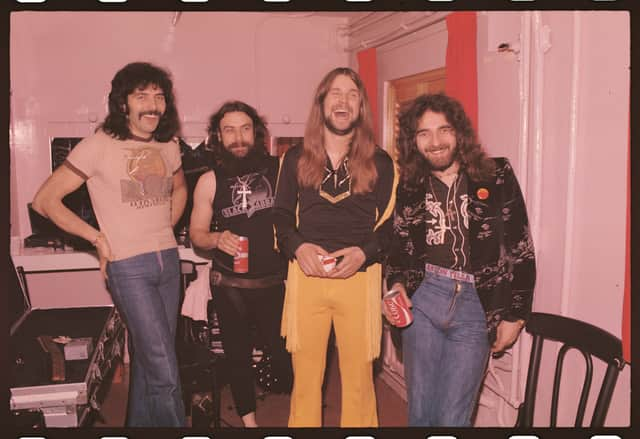

Heavy Metal fans wore ear leather and jeans with patches, a nod to the biker culture, particularly ‘outlaw groups’ such as the Hell’s Angels (see below), which make distinctive and, to be seen vaguely dangerous.
As a point of personal reflection from the very early 70s, I recall that on a Saturday afternoon, after the New Inns pub in Acocks Green closed at 2.30, my parents’ café would become the next stop for the bikers who, I must stress, were really decent though neighbours always seems horrified by them and the noise made by their ‘hogs’ (motorbikes).
They certainly played some really great music on the juke box.
So, back to the expression Heavy Metal.
Naively, I’d assumed that there’s a connection with local industry here in Birmingham, historically famed for its foundries and metal bashing.
It’s worth pointing out that before becoming full-time members of Black Sabbath, the four members had worked in factories locally.
Lead singer Ozzy Osbourne had worked as an apprentice at the Lucas car factory who also employed his mother, from whom mu own mother until she retired.
Lead guitarist Tony Iommi had worked in a sheet metal factory and lost the tips of two fingers in an accident.

Bass guitarist Geezer Butler had worked in a factory and drummer Bill Ward used to deliver coal that, back in the 1960s, was widely used and contributed to the city looking somewhat grubby look and made the environment unhealthy for those living close to factories in inner city areas.
The experience of working in noisy, dangerous and dirty manufacturing undoubtedly affected the members of Black Sabbath and influenced their desire to achieve a genre of rock to be darker and controversial than offerings by contemporary bands.
Notably, Lucas which pretty much supplied all electrical equipment for British made cars had developed a poor reputation and resulted in it being described as the ‘Prince of Darkness’.
It’s surely no coincidence that Ozzy Osbourne adopted this nickname as his nickname to align with his onstage persona.
It’s important to remember that Britain in the latter part of the 1960s was characterized by immense social change.
Many young people wanted a future different to what their parents were willing to settle for.
Heavy Metal was part of this change though the expression came from America.
Lestor Bangs, in his entry for ‘Heavy Metal’ in The Rolling Stone Illustrated History of Rock and Roll states, “Of all contemporary rock, it is the genre most closely identified with violence and aggression, rapine and carnage. Heavy metal orchestrates technological nihilism….”.
However, by the time Bangs wrote this, in the early 80s, Heavy Rock had been in existence for almost 15 years.
Intriguingly, belief that heavy metal originated in the lyric ‘I like smoke and lightnin’, heavy metal thunder’ included in Steppenwolf’s hit single “Born to be Wild”.
This song reached number two in the US charts in June 1968 and was famously employed in the radical 1969 film Easy Rider based on a story of two bikers who, having made money from a cocaine deal, travel through the American Southwest on Harley-Davidson ‘choppers’, it is now believed not to be the reason why Heavy Metal music derived its name.
There’s also been speculation that the expression derives from William S. Burroughs 1961 novel, The Soft Machine, in which he refers to one of the characters, Uranian Willy, as ‘The Heavy Metal Kid’.
Notably, the expression Heavy Metal being used to describe the new form of energetic rock music first appeared in 1970 in Rolling Stone Magazine when ‘Metal’ Mike Saunders, an American rock critic and singer in the Californian punk band Angry Samoans, reviewed Humble Pie’s ‘As Safe As Yesterday Is’.
As the expression goes, the rest is history in that Heavy Metal has spawned other forms of rock intended to create a sense of what some commentators contend will create shock and awe.
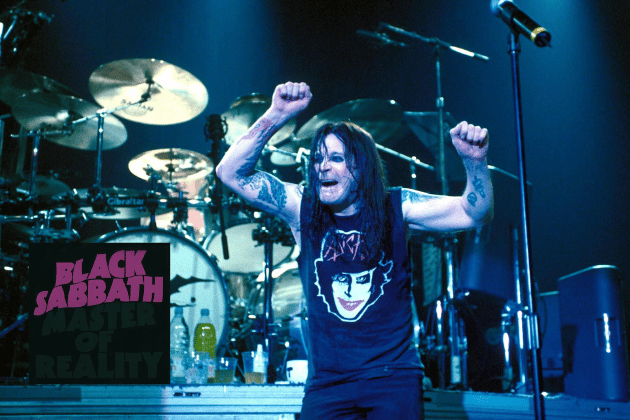
Deafeningly loud music, distorted guitar riffs, elaborate drum solos and supernatural lyrics sung at a frequently mindboggling pitch were accompanied by what frequently resembled theatrical visual lightshows and backdrops.
Over the last 57 years, the early pioneers of Heavy Metal can take credit for having spawned an incredible array of bands who’ve adapted the sound and stage effects to become ever more mainstream.
In this country this has included Judas Priest, Motorhead, Iron Maiden and Saxon.
More latterly Heavy Metal has morphed into ‘Thrash Metal’ in the likes of Metallica, Slayer, Megadeth and Anthrax.
American Heavy Metal acts include Kiss, Van Halen, Aerosmith, in the United States and AC/DC who are Australian.
In the 1980s, acts who’ve labelled as ‘Glam Metal such as Bon Jovi, Mötley Crüe and Poison emerged.
The flamboyant make-up employed by Kiss was a logical derivative of an artist who is now acknowledged to be a major influence in propagating and adapting the genre of Heavy Metal.
Alice Cooper, now 77 years old but still going strong, is regarded as the undisputed eminence grise in employing stunts to gain publicity emphasising his desire to entertain by using mock horror to emphasise lyrics and using make-up usually reserved for actors in horror films.
Though Alice Cooper is usually assumed to refer to the lead singer, real name Vincent Damon Furnier, it’s actually the band formed when he was 17 in tribute to The Beatles and called The Earwigs (see the connection!)
Renamed The Spiders and Nazz, Alice Cooper was chosen to seem inoffensive and in contrast to the band’s increasingly outrageous stage show and image.
Many stories concern Alice Cooper, the boy who went to church three times a week but had a fascination with ghosts and the weird.
Perhaps the most notable is that having been banned from Britain on the basis his influence might corrupt young minds, when finally allowed to visit, the old lady beside him on the plane to London, who he’d been talking to, went to sleep and, on landing, was found to have died.
Announcing your arrival as some sort of demonic entity doesn’t come much better than that!
Having the ability to shock, whether by accident or otherwise, is an essential leitmotif of Heavy Rock.
Which brings us back to John Michael Osbourne, better known as Ozzy Osborne, born at Marston Green Maternity Hospital on 3rd December 1948 and who grew up in Aston still recovering from the ravages of the second world war in which substandard housing was the norm.
If ever there was someone who exudes the maxim that publicity – both good and bad – is beneficial, it’s Ozzy Osbourne.
Having escaped what would have been the norm for the vast majority of his contemporaries at school, Osbourne exemplified the cliched excesses of a hedonistic the rock ‘n’ roll lifestyle by consuming copious amounts of alcohol, drugs which many believe have affected his health in recent years.
There’s also the matter of biting the heads off doves at during a meeting with CBS Records executives in Los Angeles in 1981 as well as repeating this act, this time with a bat, at a concert at the Veterans Memorial Auditorium in Des Moines, Iowa the following year.
Horrifyingly, the bat was thrown on stage by a 17-year-old Mark Neal and Osbourne assumed it was made of rubber.
The fact it was real, and alive, made the incident all the more notorious, especially the fact that it bit him and required him to have treatment to avoid contracting rabies.
Having been recruited to The Rare Breed by "Geezer" Butler, real name Terence Michael Joseph, who also lived in Aston, this band broke up but another, Polka Tulk Blues, was formed which included Astonians guitarist Tony Iommi and drummer Bill Ward, both of whom had been in Mythology that had recently broken up.
This classic line-up of what we know as Black Sabbath, was initially called Earth but required a new name when they discovered there was another band with the same name.
By selecting their name based on a 1963 Italian horror anthology film directed by Mario Bava, there’s a clear sense of the way in which the members of Black Sabbath wanted their sound and lyrics be dark and be infused with energy drawn from our innate fears.
That Black Sabbath have been phenomenally successful in selling well over 70 million records worldwide is inarguable.
As some critics contend, Black Sabbath’s willingness to be outside pop music orthodoxy made them appear dangerous and, as a consequence, seductive to teenagers wanting to rebel, as rock and roll performers had sought to achieve a generation before.
Black Sabbath achievement is acknowledgment by Rolling Stone which described their first album ‘Paranoid’ (1970) as having "changed music forever" making them the "the Beatles of heavy metal".
Notably, Rolling Stone ranks Black Sabbath at number 85 in its list of "100 Greatest Artists of All Time".
Time Magazine considers ‘Paranoid’ to be "the birthplace of heavy metal" and is among their Top 100 Albums of All Time.
Video channel MTV puts Black Sabbath as number one on their Top Ten Heavy Metal Bands and VH1 place them at number two in its 100 Greatest Artists of Hard Rock list.
AllMusic's William Ruhlmann asserts that Black Sabbath, having adapted the “blues-rock sound of late '60s acts like Cream, Blue Cheer, and Vanilla Fudge to its logical conclusion”, the band have been vital in influencing the development of Heavy Metal rock music.
Since forming in 1968, Black Sabbath have performed in venues across the world.
Unsurprisingly, Black Sabbath have regularly performed in Birmingham including the Town Hall on Friday 8th January 1971 and Monday 24th January 1972 when it was then a venue to see major acts.
Fittingly, the Town Hall is celebrating the influence of Heavy Metal in the near future when, on Wednesday 2nd July, BBC Radio WM will host ‘Metal in the Midlands’ and includes three local bands from the West Midlands, Cherrydead, Gans and Meatdripper.
That new Heavy Metal bands draw influence from the likes of Black Sabbath who’ve been around for the best part of six decades is an amazing legacy.
To those attending the Town Hall event or the extravaganza at Villa Park a few days later, I sincerely hope you enjoy the incredible sound that four working-class lads who grew up in Aston here in Birmingham helped to create.
Dr Steve McCabe
Steve is Professor and Pro Vice Chancellor, DoctorateHub.
Previously, having worked for Birmingham City Council, he spent the last 35 years as an academic at Birmingham City University teaching and researching economics, management and business. Additionally, he has written extensively for edited texts examining economics and politics.
He regularly writes and comments regularly in the national and international media on politics and the economy and has published texts on quality management, benchmarking, ‘Brexit’ and its economic and social impact, the green economy and manufacturing, house prices and India’s progress since independence.
Read more: Dr Steve McCabe Latest News