

A major incident has been declared in Birmingham as the ongoing bin strike has left an estimated 17,000 tonnes of waste piling up on the city’s streets.
It’s hard to get your head around just how much 17,000 tonnes actually is - so we asked Chat GPT for the some answers to quantify that number into real terms.
How many times could it fill the Birmingham City ground away end? How many wheelie bins adds up to 17k? Check out our handy gallery to see just how massive and environmentally dangerous 17,000 tonnes of rubbish really is to our city streets.

1. St Andrew's away end - 17,000 tonnes would fill the away end between 7 and 23 times. Based on there being 4,500 spectators it would be 7.6 times.
The away end at St Andrew’s (usually the Gil Merrick Stand Lower) holds around 3,000 to 4,000 fans. According to Chat GPT, a single stadium seat typically takes up about 0.5 to 1 cubic meter (m³). So, the away end could have a rough volume of: 3,000 m³ (tight estimate) 5,000 m³ (looser estimate with concourses, standing space, etc.) The away end at St Andrew’s could hold: 450–750 tonnes of loose rubbish 1,500–2,500 tonnes of compacted rubbish 3,000–5,000 tonnes of landfill-style rubbish | Getty Images

2. An adult male elephant - 17,000 tonnes of rubbish is about the weight of 3,400 elephants.
Yes, that's right we are comparing waste to elephants! An adult male elephant weights about 5 tonnes. Think of the scale of rubbish lining our city streets in those terms - mindblowing! Photo: Mat Hayward - stock.adobe.com

3. Olympic-sized swimming pool - 17,000 tonnes would fill 6.8 swimming pools
An Olympic-sized swimming pool has a volume of 2,500 cubic meters (m³). The weight of rubbish depends on its density: Landfill waste (~1,000 kg/m³) → 2,500 tonnes So, one Olympic pool could hold up to 2,500 tonnes of rubbish, depending on how packed it is. Photo: pio3 - stock.adobe.com
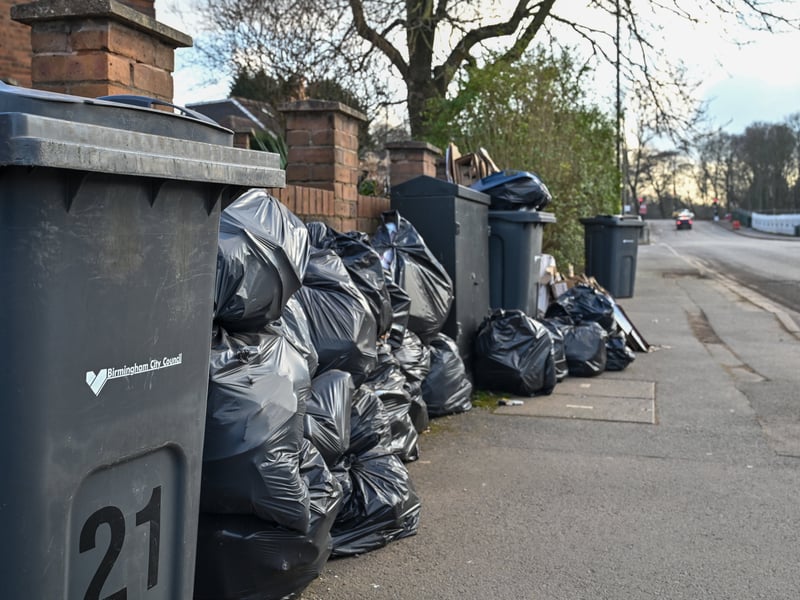
4. A wheelie bin - 17,000 tonnes would fill 1.42 million wheelie bins
A standard household wheelie bin has a capacity of 240 litres and can hold about 12kg of waste when full. | Emma Trimble / SWNS