
Award-winning graduate shows her passion for sustainable housing and urban design in projects across Birmingham
A star architecture graduate who chose an applied programme at BCU because “I wanted to get hands-on, addressing issues myself - I found that more interesting” has been working with charities and groups in the city on projects to address climate change, cut energy bills and boost access to nature.
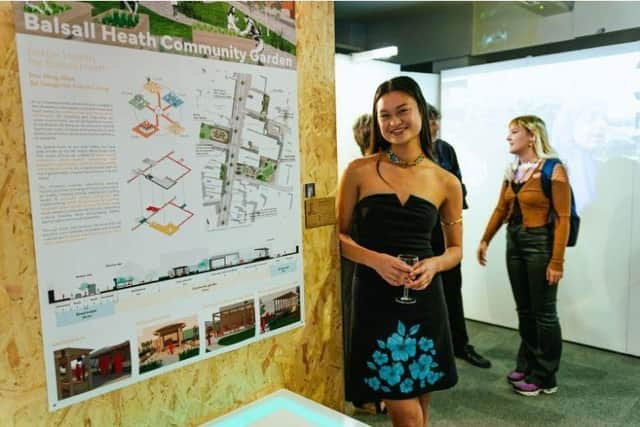
Mia-Ming Steel, from North London, won two university awards including one for top student in her year at BCU’s Architecture School for her Total Community Retrofit proposal as she graduated this summer.
Steel’s designs for Balsall Heath involve upgrading Moseley Road, with trees planted down the middle, enhanced store frontages and continuing pavement surfaces across the entrance to side streets for a better walking and cycling experience. They also include green spaces such as a community garden with a stage, marketplace, kitchen and allotment, and ‘retrofitting’ existing housing with energy efficiency improvements.
Steel and fellow graduate from the Design for Future Living BA programme, Harrison Laurie, were tasked by Birmingham faith and climate charity Footsteps to redesign the flashcards the group uses at energy saving advice events, making them more accessible. Steel has created an Instagram presence for Footsteps to reach out to a younger audience.

Collaborating with Digbeth-based marketing agency Beatfreeks and Birmingham City Council on the ‘My City is…’ project, Steel said she wanted to see a Birmingham “abundant in accessible green spaces, so that living in urban environments doesn’t mean we jeopardise our relationship to the natural world”. Over the summer, she worked with Laurie on a community project to build a health centre in Fiji.
For her suggestions for better health in Balsall Heath, she was inspired by ‘Blue Zones’ projects in Albert Lea, Minnesota and in Singapore – which try to make healthy choices easier, through urban design features and by encouraging pro-social activities via friend and neighbourhood networks.
“The more I got on with my course, the more I realised social sustainability needs to be sorted out [first]” she says.
Head of Architecture at BCU Jemma Browne says she wants to ensure her students – a majority of whom are from the West Midlands region and from ethnic minority groups, many from the postcodes of highest deprivation – to leave university “equipped [so they] can be agents of change, going out and changing the face of the profession.
"They're bringing their own lived experience, they've got the resilience that they've overcome before they get to university”.
Browne, who is also Course Director on the Design for Future Living programme, says that Steel is “so talented in so many ways, it was a privilege to teach her. Her work showcases not only technical skill but also deep understanding of sustainable housing and forward-thinking design principles and systems. She was very passionate about looking at different ways designers could engage with communities for better ways of living.
“In the end she was a clear winner in terms of how she lives the School’s values. While a brilliant student, everything she did she brought back to others as an advocate for other students. She always looked to bring people with her”.
The Balsall Heath project is “one of the best ways we get to work with community organisations,” Browne says. Local architects John Christophers and Joe Holyoak took students around the area, showing them work underway installing insulation and other energy efficiency improvements. These had been funded by government grants secured by the Retrofit Balsall Heath coalition of community organisations.
John Christophers says the Birmingham School of Architecture and Design degree show was “an absolute delight. Design for Future Living final year students collaborated with our community-led neighbourhood group Retrofit Balsall Heath and the results are stunning. Congratulations: Retrofit has come of age!”
Chris Martin of Footsteps commented: “Mia and Harrison did a great job connecting us to younger people and helping build our social media capability. They were extremely professional in their approach, delivered everything on time, used their sustainability education and were a pleasure to work with”.
The third annual Green Careers Week this week (4-9 November) is a national campaign to encourage young people to consider the huge range of roles that help communities and the planet, and the study and training pathways to access them.
In its 2023 Net Zero Workforce report, the Climate Change Committee estimated that up to 725,000 new jobs in low carbon industries could be created by the end of the decade, while WPI Economics said there would potentially be 505,000 jobs in green priority sectors by 2030.
But green careers are a bigger field than that: any job or role that contributes to preserving or restoring the environment, in any industry, not just those seen as “green”.
A wide variety of resources are available for Green Careers Week. To get involved, young people and parents can:
- Check what special events are planned at their school or college- Look out for #GCW2024 and #GreenCareersWeek on social media to see what schools, organisations and individuals are doing throughout the week- Follow @Green_Careers, @CareersWeek, @parentsguideto, @EducationGovUK and @STEMLearningUK on X to explore the latest information, films and opportunities as they’re released- Visit www.greencareersweek.com and www.greencareershub.com to access the latest resources and information