
Inside Amazon's £500m Sutton Coldfield mega-warehouse: a closer look

Amazon’s Sutton Coldfield fulfilment centre is still a world unto itself. Mark Morris steps inside to discover what sets it apart - and to witness, up close, the algorithms, robotics, and vast scale that keep it moving.
‘The fulfilment center in Sutton Coldfield cost £500m to build’
The true scale of Amazon’s Fulfilment Centre EMA4, just outside Sutton Coldfield, only hits you as you sweep past on the A38 and see it rising. It’s not just a warehouse, it’s the warehouse of warehouses, the factory of factories, a vast, steel-skinned behemoth of modern logistics.
Pulling into the car park feels a little like crossing into a border zone - part airport, part shipping port - a place with its own rhythms and rules.
‘The building is roughly 650,000 sq ft over 4 floors’
Inside, the welcome is warm. The air smells faintly of newness and freshly cleaned floors. Everything is factory-clean, as is the norm in modern manufacturing and logistics, and the safety-first culture is unmistakable, with giant green signs greeting you before you’ve even taken a step.
To my right, endless banks of lockers hint at the sheer number of people who work here. In the staff room, there’s even a Super Mario-themed corner, a splash of playfulness in what is admittedly a cathedral of efficiency.


‘Circa 2,500 people are employed at EMA4, interestingly, more than at a non-robotics centre’
Before I get into how Amazon’s vast machine actually works, and the role fulfilment centres like EMA4 play in that complex yet strangely simple jigsaw, there’s a small detail or two worth pausing on.
Step through reception, collect your visitor’s pass, and the first thing you notice is that HR isn’t tucked away in some back-office suite. It’s right there, on the shop floor. Not in the corporate sense, either - it looks more like a service counter, the kind you’d see at a big Eurocar desk in an airport.
Amazon says this is deliberate. It makes HR more visible, more approachable, and, in line with the company’s “customer first” mantra, the employees here are the customers. A similar training and development hub sits just a few steps away, also in plain view.
‘Most employees will work 4 days on 3 days off, shifts are 10 hours’
On the training front, everyone - yes, even the suits - goes through the same rigorous two-week induction. The idea is that anyone can roll up their sleeves and pitch in operationally as well as administratively. During Black Friday, for instance, you might see the building’s management team right alongside the packers, sealing up boxes for dispatch across the region and beyond.
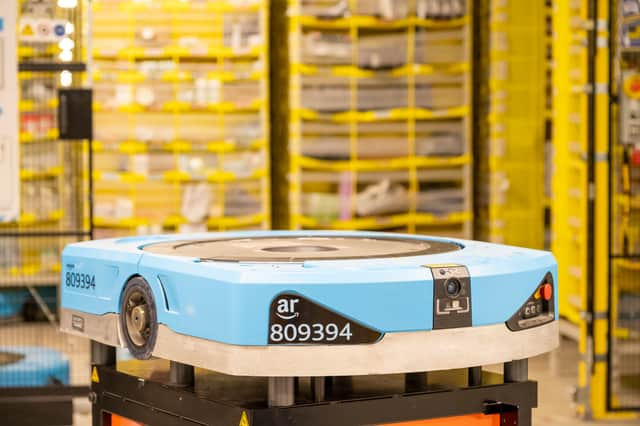
How Amazon works in 5 steps:
- Products from enterprises and other sellers arrive first at Amazon’s Receive Centres - one in Doncaster, one in Coventry.
- An algorithm analyses historical sales data to decide how much stock to send to each of Amazon’s 32 UK fulfilment centres, including Sutton Coldfield.
- Receive Centres don’t store products. Instead, stock is sent to fulfilment centres, where it’s stowed, by a combination of advanced robotics and human workers, until ordered.
- When an order is placed, robots locate the item in storage. A human packs it, a computer system called SLAM checks it and applies your address label etc, and decides which gate it goes to to be transported to a sortation centre. This is very airport-esque.
- From the sortation centre, where it is given a more ultra-local final destination, it moves to a delivery station, where Amazon’s delivery partners collect it and take it to the customer’s door.
From shelf to doorstep

On the ground floor, a vast expanse, perhaps half the space, is given over to inbound goods. Like most Amazon fulfilment centres, Sutton Coldfield handles smaller items, while other UK sites specialise in larger products, apparel, shoes, food, and drink.
Every item is checked, placed into a black storage box, and set onto one of the centre’s miles of conveyor belts. The belts carry the boxes to the next stage, where people load them onto tall storage carts.
“The centre has 15 miles of conveyor belts.”
From there, the real magic begins. These carts are whisked away by independent robots, no tracks, just coded markers on the floor and a remarkably smart algorithm guiding them to the right storage location. While big supermarkets use similar technology, it’s hard to convey just how advanced Amazon’s system is.
The robots are self-sufficient: they take themselves to a scanner - a kind of X-ray machine - that updates the system on how much space remains in their cart. When their batteries run low, they roll themselves over to a charging station, plug in, and wait until they’re ready for duty again.
Seeing the sheer volume - thousands of products passing through EMA4 every single day - it’s hard not to be awed. The choreography between human hands, algorithms, and tireless machines is so intricate, so seamless, it’s almost beyond description.
All of that happens before you’ve even clicked ‘Buy’ on Amazon.co.uk.
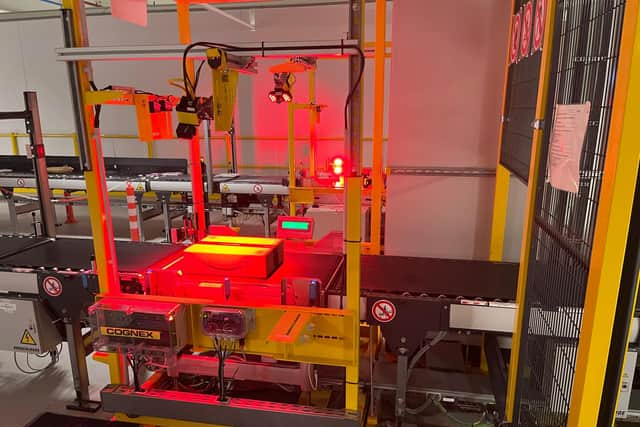
Once you do, an entirely new chain of processes springs into life. The system already knows exactly where your item is - it was logged and stored by robots the moment it arrived. A robot heads to the location, retrieves it, and sends it gliding along the conveyor belts back down to the ground floor.
What happens if you order two items from two different sellers
“If your order involves two separate items from two different sellers, and you’ve asked for them to arrive together, a clever synchronisation system kicks in. It uses lights and signals to make sure both products meet at the right point in the process, a level of coordination that’s almost too intricate to put into words.”
For single-item orders, the product moves straight to packing. Here, the process is led by people, but with precise technological support: machines cut the exact length of tape needed for each box, calculate the right amount of paper padding, and display the instructions to the packer, speeding the job up while avoiding waste.
From there, the parcel is weighed, checked, and given its address label. This is part of an automated process known as SLAM, short for Scan, Label, Apply, Manifest. At the end of SLAM, the system decides which gate the package should head for, ready to be loaded onto an HGV bound for a sortation centre. There, it will be sorted once more before travelling to a local delivery station, where an Amazon partner collects it and takes it to your door.

This sequence plays out thousands upon thousands of times every hour across the UK. If anything falters, if the delicate balance between inbound and outbound shifts, an engineering team, based in the heart of the building, monitors giant screens to respond instantly. We weren’t allowed to photograph them. Most operations staff here are trained across multiple roles, ready to switch tasks at a moment’s notice to keep the flow moving.
And while it pauses briefly each day for routine maintenance, this system remains the very definition of keeping things moving.
Lessons from a logistics giant
Part of the reason for detailing these workflows, beyond the sheer fascination of them, is that their sophistication and efficiency are on a level most organisations could never hope to replicate. But they can still serve as inspiration.
Amazon attracts its share of criticism for many reasons, but on the logistics front, it’s hard to argue with the results. This is efficiency and business technology at its peak, and when it comes to best-in-class operations, there are very few anywhere in the world that come close.